Posted by wilde on July 31st, 2008 — Posted in Vegetable
The last couple of wildflowers that I identified popping up in our lawn were introduced species, which means they’re not native to North America. You could call them aliens, or exotics.
The main problem with introduced plants is that they often go wild, literally. Typically, no pests or predators consume enough of the plant or control it by other means, so the new kid on the block acts like an invader. Seeds are easily spread by animals, birds or the wind. Runners and suckers help the aliens invade new territory.
Invasive plants crowd out native plants and the problem with that is that we lose biodiversity. A highly diverse ecosystem has been shown scientifically – over and over again – to be more stable than a less diverse ecosystem. What that means for all of us is that when we lose biodiversity we lose a little stability. When nature becomes unstable, bad things happen.
So far, we’ve done some really bad things, like polluting the waterways so badly that a river actually caught fire in the 1970s and fish populations in the Great Lakes were totally decimated to recover some decades later. Enacting legislation, like the Clean Water and Clean Air Acts, to right these wrongs aided in the recovery.
Looking at things long-term, one sees that it would be much better for us, as the human race, to strive to stabilize our environment.
Perhaps an over simplification, but the endpoint is clear. We need to keep our environment of a high quality and stability if we are going to survive.
Concerning plant invaders, the worst of the bunch has been identified and legislated against. The U. S. Department of Agriculture has compiled a list of links to federal and state noxious weed lists.
Pennsylvania’s Noxious Weed List names 13 plants that are illegal to propagate, sell or transport in PA:
1. Canada Thistle, Cirsium arvense
2. Multiflora Rose, Rosa multiflora
3. Johnsongrass, Sorghum halepense
4. Marijuana, Cannabis sativa
5. Mile-a-Minute or Tear-thumb, Polygonum perfoliatum
6. Kudzu-vine, Pueraria lobata
7. Bull or Spear Thistle, Cirsium vulgare
8. Musk or Nodding Thistle, Carduus nutans
9. Shattercane, Sorghum bicolor ssp. drummondii
10. Jimsonweed, Datura stamonium
11. Purple loosestrife, including all cultivars, Lythrum salicaria
12. Giant hogweed, Heracleum mantegazzianum
13. Goatsrue, Galega officinalis
I’ve seen many thistles growing by the roadsides in the country out here and probably at least a few of them are on this weed list. The Mile-a-minute and Loosestrife I’ve seen in nearby areas, but I only recall seeing the Kudzu vine in Virginia and places further south.
We have Multiflora Rose growing all along the dirt road up to the house and I do think it grows very quickly judging from the last three years changes. We’re going to tear some out this fall and replace it with raspberry plants. That way, we can still enjoy the flowering, have some delicious fruit for the picking, and help reduce the invasive plant burden on the Pennsylvania natives.
Where you live, do you see any of these bad weeds?
I read an article in a recent Conservationist magazine, from New York State, that addressed an additional problem with Giant Hogweed. Some people are so sensitive to the plant that contact with it produces blisters. Kind of like the burns you can get from parsnips in the garden if you handle them with the morning dew still on them! If you’re going to get rid of some Giant Hogweed, send me a picture first and I’ll post it here for all to see. Oh yeah, wear long sleeves and gloves, too!
No Comments »
Posted by wilde on July 30th, 2008 — Posted in Vegetable
We don’t take a lot of pains to keep a manicured lawn, not even in the front of the house. Being in a rural setting, we don’t have a neighbor’s neatly trimmed lawn right next to ours to make it look too long. Let’s just say the yard has a rough look to it!
Besides saving time, money on gas and oil, and polluting the air less than the Jones, I’m having a little fun letting the wild flowers grow. I actually mow around the volunteer plants that look interesting or seem like they’ll flower.
New wildflowers have been allowed to pop up through the thin grass. Some fleabanes have gotten five feet tall – as tall as a little peach tree that I transplanted last year – and there’s a few I have yet to identify.
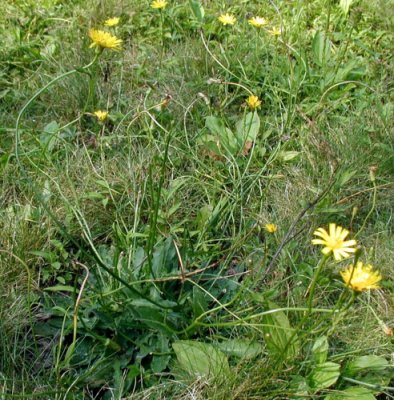
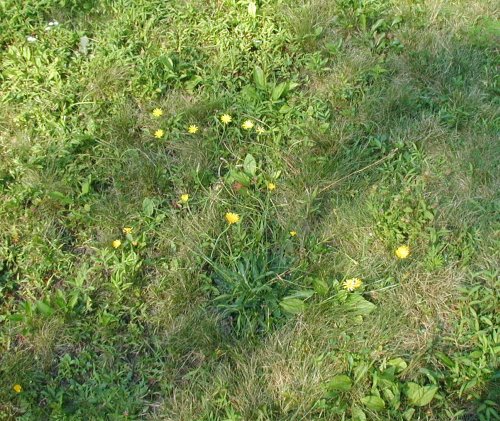
A couple of very similar looking “tall dandelions” appeared in the lawn and they have been saved from the cut of the mower – for now. These plants are composites, or members of the daisy family.
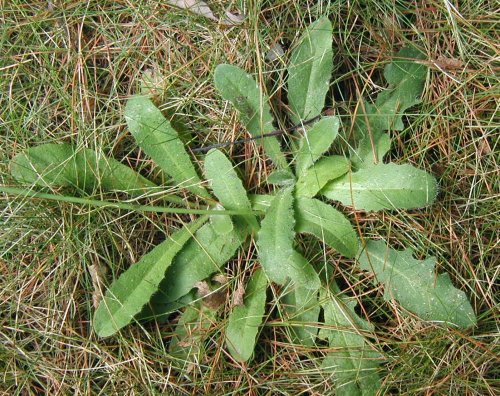
Both of these plants have rather thick and fuzzy, or hairy, leaves arranged in a basal rosette. A single stem rises up from the basal leaves to a somewhat branched head having a few to several yellow, dandelion-like flowers.
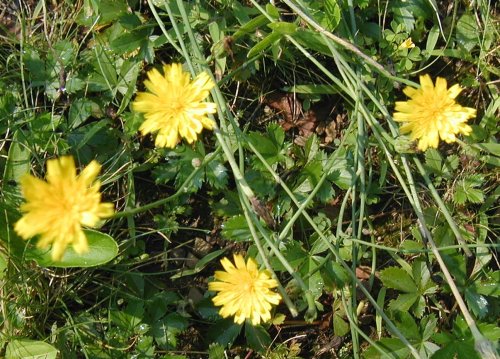
Looking down on this flower you might think it’s a dandelion, but on closer inspection the tall stem and the thick, hairy leaves tell you it’s not a dandelion.

Photo, taken 26jul08, looking down on a dandelion-like, yellow flowering weed.
From a side view the stems obviously come up from a single point. The stems themselves are thin and quite different from the hollow tubes of a dandelion’s flower stem.

Photo, taken 26jul08, from Juniata County, Pennsylvania.

Bright yellow flowers of a ‘hawkweed-type’ wildflower, taken 26jul08.
Flowering of the two plants was separated in time by a few weeks. The taller of the two bloomed in June and the flowering of the shorter stemmed plant is just now petering out.
Leaf shape and the arrangement of the flowers helps to identify each of these plants.
Shorter stem with 2-5 branches each having a single flower. Leaves are lobed, but in a such a way that each leaf looks unique, and very hairy. Stems reach up to 16 inches, but some stems may be half that tall. A few scales are scattered on an otherwise smooth stem. Identified as Cat’s-Ears, Hypochoeris radicata, an alien.
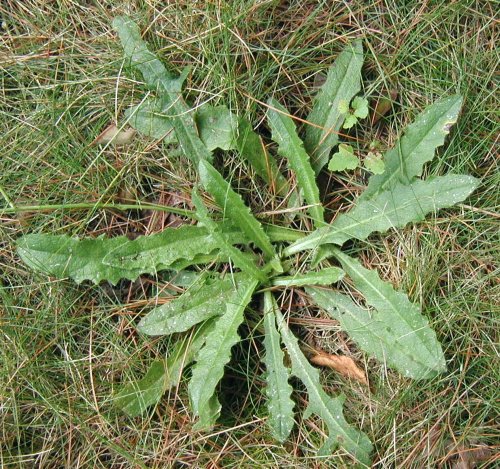
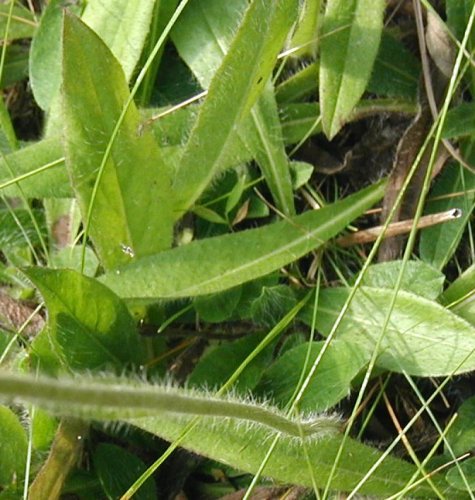
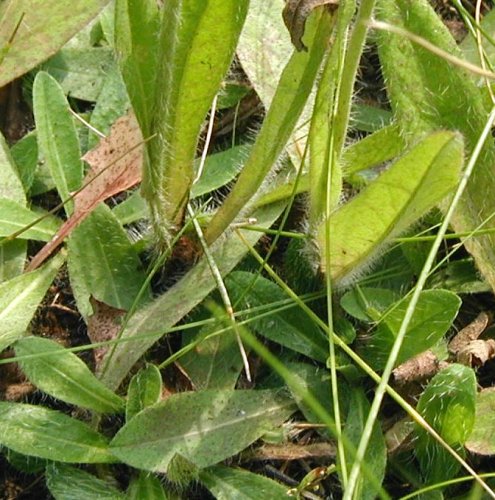
Tall stem, 1-3 feet tall, with a group of flowers in a compact head. Untoothed, linear leaves are hairy on both sides. The stem and bracts have hairs as well, black ones at that. Identified as Field Hawkweed or King Devil, Hieracium pratense, an alien.

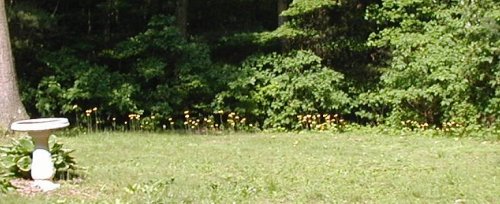
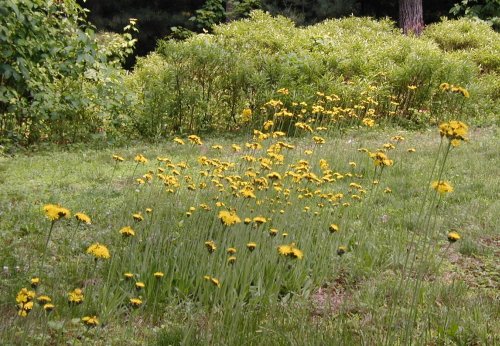
Flowering during the first week of June the Field Hawkweed stands about 2 feet tall, as seen from across the backyard on 07jun08.

Taken last year (02jun07) this photo shows four large mats of flowering Field Hawkweed.

Taken 20jul08, this photo shows the limited branching of the Cat’s-Ears stem that rises up from the rosette of leaves. In this case there were four terminal blossoms.


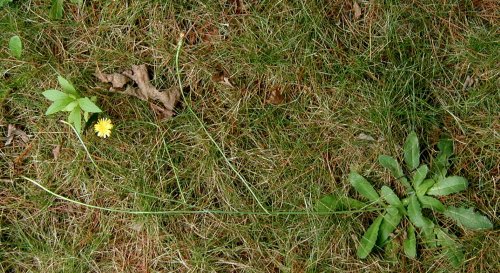
Basal rosettes of hairy leaves of the Cat’s-Ears, taken 20jul08. Note the variety of lobe shapes on these leaves.
Basal leaves of the Field Hawkweed are entire and do not have lobes or teeth.


Field hawkweed leaves are quite hairy and the hairs are very noticeable.

Close-up side view of a grouping of flowering Field Hawkweed, taken last year (02jun07).
Neither plant appears to have any medicinal or edible value, but they do have ornamental value. When they’re done flowering, they’ll be mowed and looked for again next year.
2 Comments »
Posted by wilde on July 26th, 2008 — Posted in Vegetable
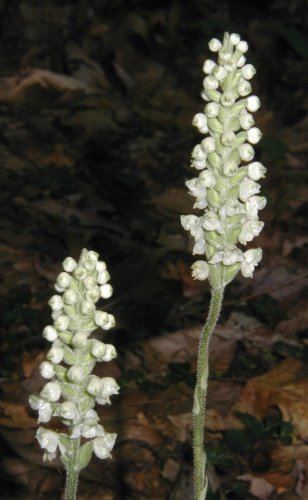
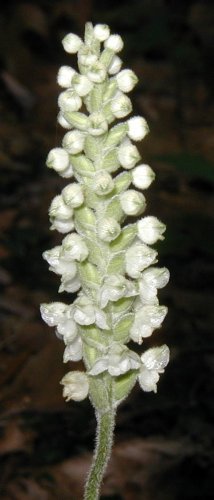
The Downy Rattlesnake Plantain started opening its blooms this week. Each of these orchids has a few dozen quarter-inch long blooms at the top of a fuzzy stem with about a third of the blooms open.

You can see why this orchid is called ‘downy’ as all parts of it seem to be fuzzy with soft, downy hairs.

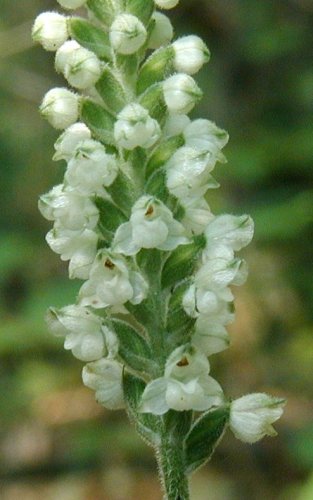
Here’s a similar photo taken without a flash. Details of the open flowers are more visible.

Three sepals are the same white color as the petals, except for a tinge of green at the sepals’ edge. The two upper petals are merged into a hood. The lower petal is enlarged into the typical cupped lip of an orchid.
No Comments »