We don’t take a lot of pains to keep a manicured lawn, not even in the front of the house. Being in a rural setting, we don’t have a neighbor’s neatly trimmed lawn right next to ours to make it look too long. Let’s just say the yard has a rough look to it!
Besides saving time, money on gas and oil, and polluting the air less than the Jones, I’m having a little fun letting the wild flowers grow. I actually mow around the volunteer plants that look interesting or seem like they’ll flower.
New wildflowers have been allowed to pop up through the thin grass. Some fleabanes have gotten five feet tall – as tall as a little peach tree that I transplanted last year – and there’s a few I have yet to identify.
A couple of very similar looking “tall dandelions” appeared in the lawn and they have been saved from the cut of the mower – for now. These plants are composites, or members of the daisy family.
Both of these plants have rather thick and fuzzy, or hairy, leaves arranged in a basal rosette. A single stem rises up from the basal leaves to a somewhat branched head having a few to several yellow, dandelion-like flowers.
Looking down on this flower you might think it’s a dandelion, but on closer inspection the tall stem and the thick, hairy leaves tell you it’s not a dandelion.
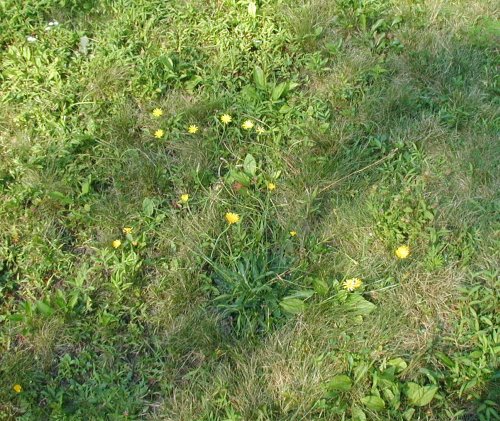
Photo, taken 26jul08, looking down on a dandelion-like, yellow flowering weed.
From a side view the stems obviously come up from a single point. The stems themselves are thin and quite different from the hollow tubes of a dandelion’s flower stem.
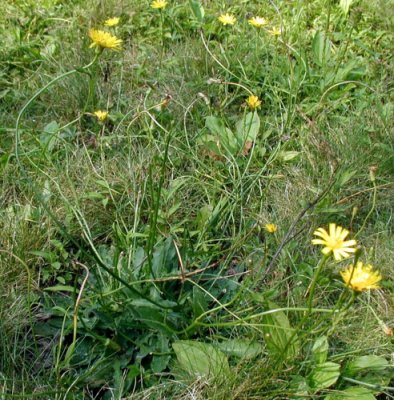
Photo, taken 26jul08, from Juniata County, Pennsylvania.
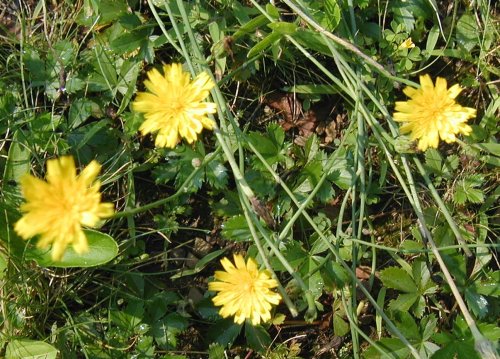
Bright yellow flowers of a ‘hawkweed-type’ wildflower, taken 26jul08.
Flowering of the two plants was separated in time by a few weeks. The taller of the two bloomed in June and the flowering of the shorter stemmed plant is just now petering out.
Leaf shape and the arrangement of the flowers helps to identify each of these plants.
Shorter stem with 2-5 branches each having a single flower. Leaves are lobed, but in a such a way that each leaf looks unique, and very hairy. Stems reach up to 16 inches, but some stems may be half that tall. A few scales are scattered on an otherwise smooth stem. Identified as Cat’s-Ears, Hypochoeris radicata, an alien.
Tall stem, 1-3 feet tall, with a group of flowers in a compact head. Untoothed, linear leaves are hairy on both sides. The stem and bracts have hairs as well, black ones at that. Identified as Field Hawkweed or King Devil, Hieracium pratense, an alien.
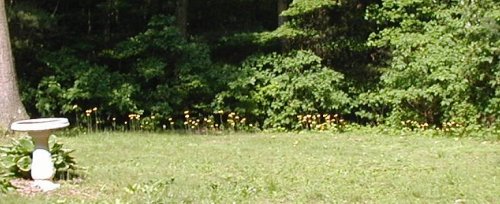
Flowering during the first week of June the Field Hawkweed stands about 2 feet tall, as seen from across the backyard on 07jun08.

Taken last year (02jun07) this photo shows four large mats of flowering Field Hawkweed.
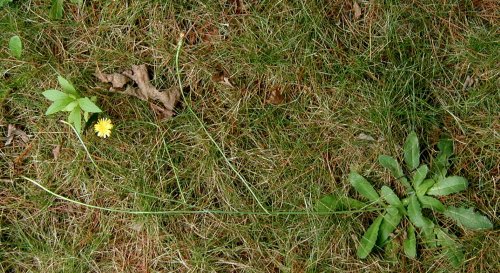
Taken 20jul08, this photo shows the limited branching of the Cat’s-Ears stem that rises up from the rosette of leaves. In this case there were four terminal blossoms.
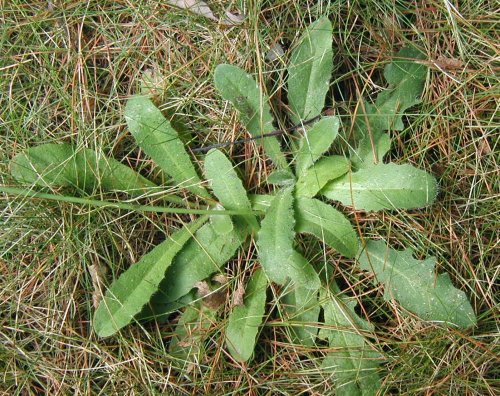
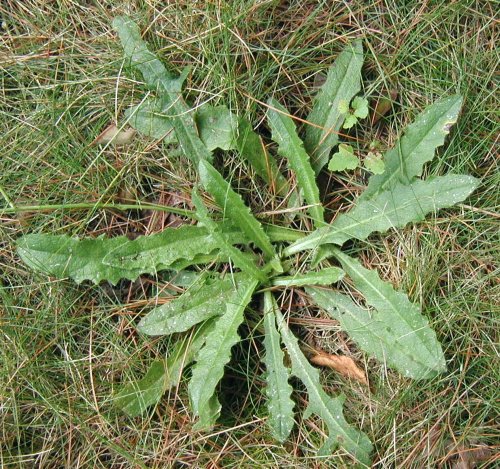
Basal rosettes of hairy leaves of the Cat’s-Ears, taken 20jul08. Note the variety of lobe shapes on these leaves.
Basal leaves of the Field Hawkweed are entire and do not have lobes or teeth.
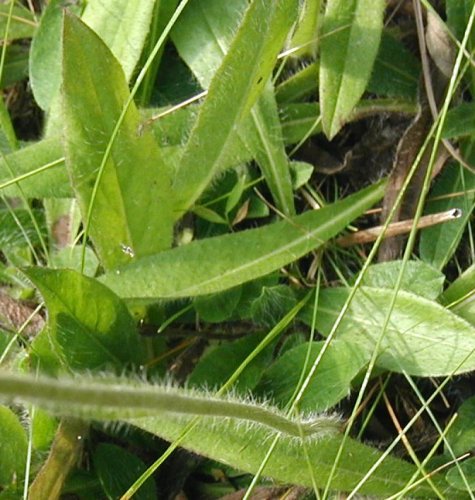
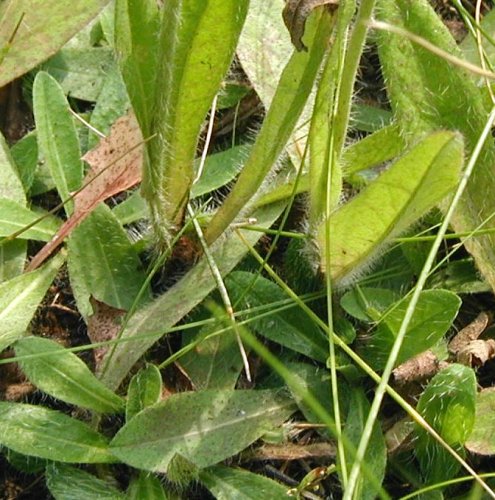
Field hawkweed leaves are quite hairy and the hairs are very noticeable.
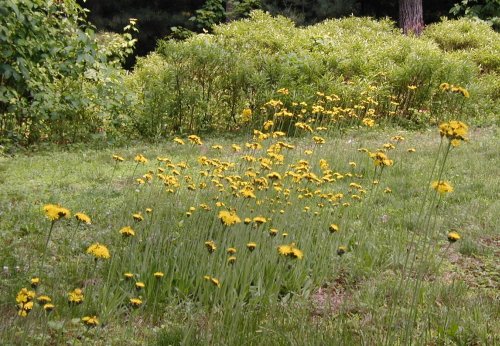
Close-up side view of a grouping of flowering Field Hawkweed, taken last year (02jun07).
Neither plant appears to have any medicinal or edible value, but they do have ornamental value. When they’re done flowering, they’ll be mowed and looked for again next year.
I’ve been looking into dandelions because my children seem to like them and I’ve gorwn to accept their charm especially the idea that they are medicinal. I found that in my yard, the dandelion look-alikes are taking over the lawn. I decided not to get rid of them. But some have reached a height of almost 2-3 ft (or more) and produce a milky sap when cut. The leaves are spikey but don’t seem to hurt. However they are unsightly especially since we do have neighbors that keep their lawns at least trim. I recently noticed what could be cat’s ear or hawkweed growning. I’ve heard that the catsear is edible and should be cultivated the same way as the dandelion. Not sure about the hawkweed though.
Hey Neka,
I’m not too sure that you should eat either the cat’s ears or the hawkweed. Their qualities for food or medicinal use are questionable. Neither one appears in the Peterson field guides for edible or medicinal plants.
Both are aliens to the U.S. and both can be invasive. If you just let them grow you’ll probably soon have more than enough. I like to let the hawkweeds flower so I mow around the plants for the first couple times in the Spring. Although it’s temporary, it’s like a free wildflower garden. They get mowed down when the flowering seems about over. The Field Hawkweed is in full bloom today as it’s nice and sunny.
The Cat’s-Ears doesn’t put on as nice of a display as the hawkweed does. Hawkweed appears in great mats of a few dozen plants, while the cat’s ears appears in small clumps of a handful of individual plants.
Hey you all weed killers.
There you are spending time and money
trying to get rid of whats is good for you.
For thousands of years this weeds have been used for medicinal purpose and if you check the products you purchase today you will find they contain all this weeds. Do your homework!!!!
They want you to continue paying for medicine and continue paying for chemicals to destroy the free medicine.
Foolish
Wake up
Hi Jose,
I agree totally with you that people should put down their chemical sprayers and think about what they are really doing. No one looks at the long term effects when they want something instantly. Too bad for the people that come up behind us.
I like your thought that people want to continue to “pay for chemicals to destroy the free medicine”!
Stay green and stop by again!
Neka according to John Kallas, PhD. Cats ear is edible. In the book “Edible Wild Plants” He discribes the plant, includes photos, and has recipies. Usually the plant grows very close to the ground, making it hard to clean the dirt off of the leaves. The flowers, stems, buds, and leaves are all edible. They contain lutein, carotinoids, antioxidants, and antiradicals. Many buds can be gathered and eaten like asparagus. It is about 1/2 as bitter as dandelion.
I have a plant in my backyard that looks like cats ear except that the center of the flower is yellow, with white pedals around the perimeter. Does anybody know what it is?
Hey Keith,
Have you tried dandelion and cats ear? Just curious on your take of the bitterness of each!
Spring’s coming and it’ll soon be time to try both.
I let both of these go to seed….. the goldfinches LOVE them and descend on our yard in large flocks. The Eastern bluebirds use the white fluff to line their nests with.
And me? Well, I enjoy the FREE COLOR!!! Oh, I forgot to mention the bees, moths, butterflies and spiders which all love them, too.
Lisa,
Since we’ve been letting these go to seed there are more of them in the yard and more color. Like a friend once said, if we didn’t have weeds we wouldn’t have much of a lawn. At least ours is green! A lot of the lawns have been mowed too closely and with the very hot weather we’ve had, well, let’s just say the remaining brown tufts of grass may blow away soon.
The goldfinches appear here in numbers when the purple coneflowers are going to seed. They really love those things.
Thanks for chiming in and enjoy your color!
Cats ears and dandelion are plentiful here in South Carolina. I have eaten both. Tonight I made a lovely stir fry featuring cats ear buds and blossoms(since the leaves are now too tough and stringy), asian dayflower shoots, nasturtium leaves, basil, calamint, and beef, finished with sundried tomato butter. I suffer no ill effects, but not everyone can eat everything.
That’s great, Christy.
The basil and nasturtium leaves probably gave your dinner some nice flavors. Did you remove the bracts of the cat’s ears buds before stir frying? Dandelion bracts are bitter so I was curious if these were too.
The sundried tomato butter sounds like a great topper. Did you make it?
I just left the bracts on the cats ears, and a bit of stem on a few too. I bought my sun dried tomato butter from a local supermarket for a recipe I had used previously. When my tomatoes come in, I am definitely taking a shot at making my own, though I am not certain I will succeed with the sun drying process.
Thanks for your tips! I definitely will be looking for the cat’s ears before they bloom to sample them.
If the sun drying process doesn’t work, you could roast the tomatoes in the oven. They develop a really rich or deep flavor that is similar to sun-dried. Good luck!
Have watched rabbits seek them and “Snip” a tall one, low and munch one a foot long about nonstop from the bottom up, flower and all, like one would appear eating a single length of a spaghetti noodle but chewing it in, devored in about 30 seconds and get another.
Hey Jim!
We like to watch the wildlife too and have seen bunnies eat dandelions and violets in the same manner. I guess they were telling us that these things were ok to eat.
Thanks for chiming in!
I let all my wildflowers go nuts…I love looking at them and the colors are beautiful…I have phlox in a variety of colors , wild roses..very small but what a scent,yellow hawkweed,daisies,violets and its only June. Growing in between these flowers are wild strawberries. This spring I had crocus,trout lily and jack in the pulpit. I can’t wait to see what else pops up during the summer and into fall.
It’s like a box of chocolates, right Trish?
Right now we have a great wild bouquet of hawkweed in the backyard. Several of the flowers you mentioned we’ve enjoyed this spring too. The one wild rose is a mottled red and white with simple leaves – something that you’d never see offered in a garden store. Yesterday I ate 3 wild strawberries, so yeah! – we have fun watching Mother Nature at work. Up next are the daylilies!
Hawkweed and Cat’s Ear are both edible. Cat’s Ear has similar medicinal properties as dandelion but it is not as bitter as dandelion which is to say not as potent medicinally. Not sure about medicinal values of hawkweed as I don’t yet have very much experience with that one. Always thoroughly research any plant before utilizing. Better to consult a local reputable expert.
Hey Todd,
Thanks for your input on these yellow flowering yard weeds. It’s great to know a little more about these plants we find locally.
I do like your advice to consult a reputable expert before using these plants. Better safe!