Longleaf Summer Bluets Flower Among Blades of Grass

Posted by wilde on July 7th, 2010 — Posted in Vegetable

A perennial yard weed that is really cute appears in late Spring and may be found flowering until mid-Summer. We see it in the lawn and near the edges of the lane where it grows in gravel and dry rocky soil at the top of the mountain ridge.

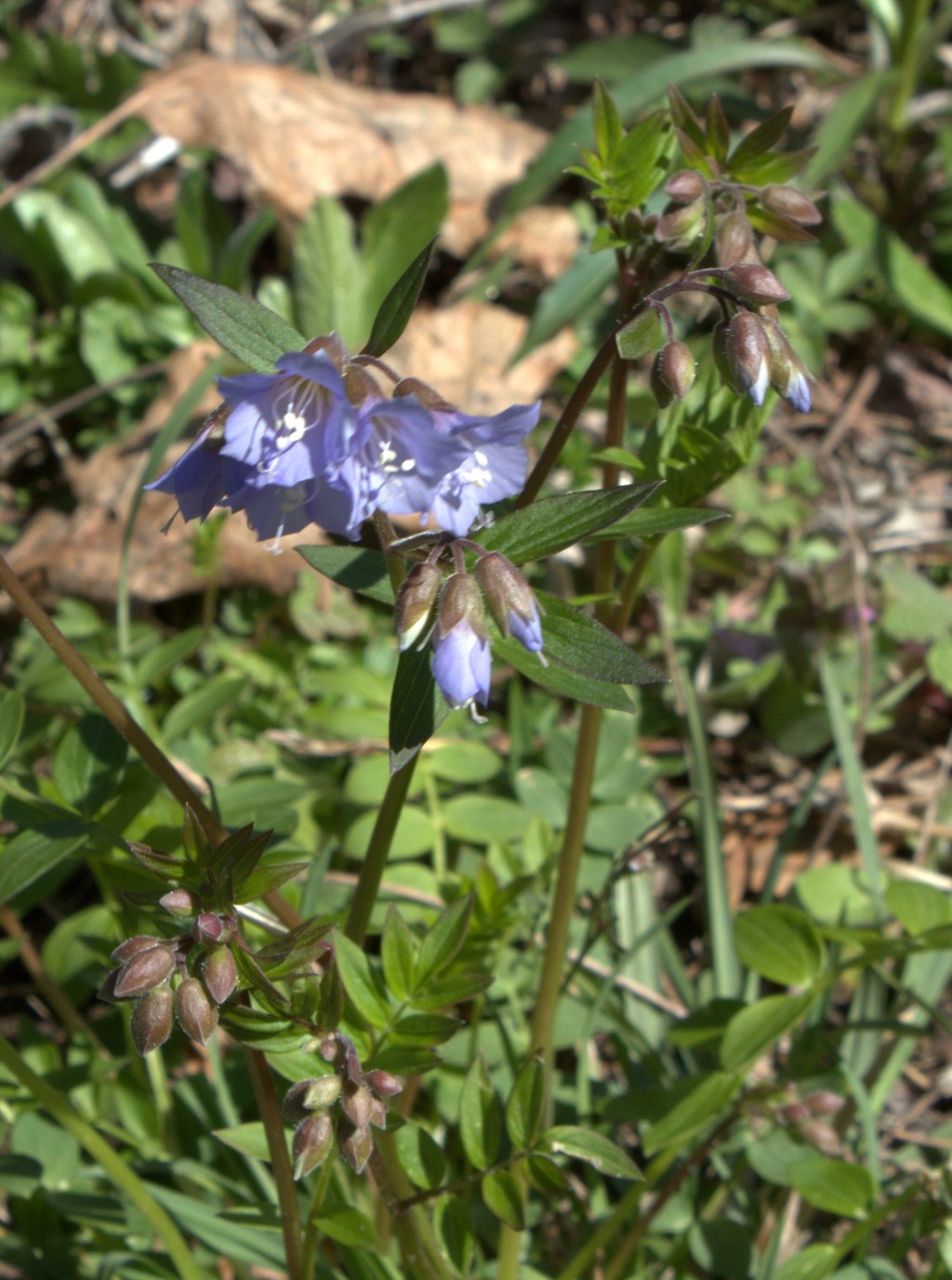
The trumpet-like flowers have a long bell with four flaring petals in white with tones of lavender. The flower buds are a rosey-pink to lavender color. Photos below taken on 8 Jun 2010.

Clusters of small trumpet-like flowers held above pairs of narrow leaves.

Clusters of small trumpet-like flowers held above pairs of narrow leaves.

Narrow, strap-like, sessile leaves are opposite one another on branching stems that barely reach ten inches tall.

Longleaf Summer Bluet, Houstonia longifolia, may also be known as Long-leaved Bluet. Its flowers are in small clusters and are more trumpet-like than the flowers of Bluets, which are not in clusters. Bluets have a way of holding their yellow eyed flowers up to the sun that the Longleaf Summer Bluet lacks. Its flowers are often held out to the sides.

Longleaf Summer Bluets bloom among the grass in the lawn.

Longleaf Summer Bluets bloom among the grass in the lawn.

In parts of New England the native Longleaf Summer Bluet is considered threatened. It is listed as endangered in Connecticut and Massachusetts, it’s of special concern in Maine, and it appears only in historical records in Rhode Island, which means the Longleaf Summer Bluet may already be extirpated there.

We seem to have plenty of the long-leaved bluet here on our mountain ridge in PA, but I haven’t seen it anywhere else.

Sumac Flower Buds and Red Berries

Posted by wilde on July 6th, 2010 — Posted in Food, Vegetable

Sumac seems to be everywhere around here. If you looked at the wood’s edge, most likely you could find a few sumac shrubs or little trees. It is a common plant, but there are a few different kinds of sumac. One is poisonous, but that occurs mostly in swamps. We don’t have that habitat up here on the mountain ridge, but we do have to keep our eyes open for poison sumac’s nasty cousin, poison ivy!

The Audubon North American Field Guide to Wildflowers describes Fragrant, Poison, Smooth, Staghorn and Winged Sumac in Eastern North America. Smooth, Poison and Fragrant Sumac all have smooth twigs. To be sure, Poison Sumac leaflets are not toothed and its berries are white.

Fragrant Sumac, Rhus aromatica, is a little different in appearance as it only has three leaflets to its compound leaves, where the other sumacs have many more leaflets, like 9 to 31 leaflets.

Smooth Sumac, Rhus glabra, is definitely smooth on the twigs and the many leaflets are untoothed. The leaf stems have a nice blush of purple on them. (Photo of smooth sumac taken on 30 June 2010.)

Smooth sumac berry cluster and several leaves with many untoothed leaflets.

Smooth sumac berry cluster and several leaves with many untoothed leaflets.

Winged Sumac can be differentiated from Staghorn Sumac by the presence of a winged midrib between the leaflets of its pinnately compound leaves. Leaflets are untoothed in Winged Sumac.

Staghorn Sumac, Rhus typhina, seems to be the primary species of Sumac in our area. Characteristics that mark this sumac are its hairy twigs, toothed leaflets, and reddish hairs on berry-like fruits. Flowers are green in terminal clusters.

Compound leaves of Staghorn Sumac with many pairs of toothed leaflets.

Compound leaves of Staghorn Sumac with many pairs of toothed leaflets.

Cluster of green flowers and hairy twigs of Staghorn Sumac. Flowers are just beginning to open.

Cluster of green flowers and hairy twigs of Staghorn Sumac. Flowers are just beginning to open.

Another view of Staghorn Sumac blooming.

Another view of Staghorn Sumac blooming. Photos above taken 6 June 2010.

A type of pink lemonade can be made from the ripe red berries of Staghorn Sumac in the summertime. Peterson’s Edible Plant Guide says to bruise the berries, soak for 15 minutes in cold water, strain out the hairs and berries with cheesecloth, sweeten and chill.

Does anyone out there feel adventurous enough to try sumac lemonade? Let us know how you make out!

Enhanced by Zemanta