Autumn Violet and Holly Berries

Posted on 31 October 2006 by wilde

Leaves are falling all around us. Almost time to get the gutters cleaned out!

Fall colors weren’t as brilliant this year. Some say it has to do with the amount of moisture. I don’t know, but I still enjoyed seeing the change from green to yellow, orange and red in the forest canopy.
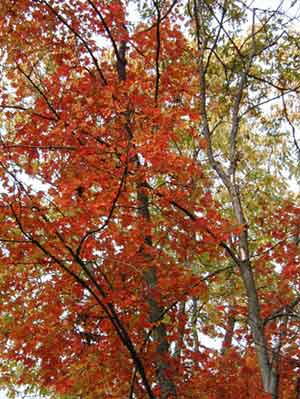
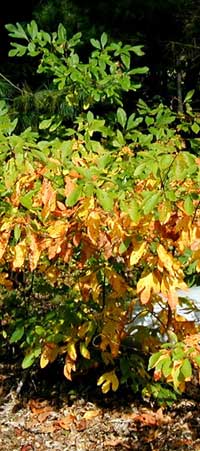
Near the edge of the woods a maple tree bares its trues colors.

Near the edge of the woods a maple tree bares its trues colors.

We have had a good deal of moisture lately here in Central Pennsylvania. Maybe that spurred a violet into thinking it was time to show her blossom. I was surprised when I saw the purple flower, but it did remind me that several factors govern the timing of plant growth — namely, the recent temperatures of the microclimate, the amount of daylight received by the plant, and moisture levels.

Evidently, some factors are more important than others for certain members of the Kingdom Plantae.

A violet dares to be different and is found blooming in autumn.

A violet dares to be different and is found blooming in autumn.

Of course not much else is blooming right now. The only bright colors we’ll likely see for another month are the berries. Bright red partridgeberries can be found along the paths in the woods where leaves haven’t completely covered them over. Red berries on the holly trees planted near the woods edge foretell the holiday season that will soon be upon us.
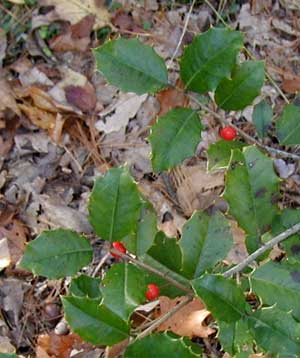
Red holly berries remind me of the coming winter holiday season.

Red holly berries remind me of the coming winter holiday season.

Until the harsh winter winds blow the white stuff around, a pile of leaves will help protect a few of the culinary herbs near the house. We should be able to gather a few sprigs of oregano, mints, lavender and catnip for a while longer.
Red Berries of the Smooth Sumac

Posted on 10 October 2006 by wilde

Trees are changing colors. Maple leaves lighten their green and give way to yellows, oranges and bright reds that are some of the most vibrant colors of autumn. The yellows of the birches and ashes are followed by the oaks with their brown leaves that finish off the season.

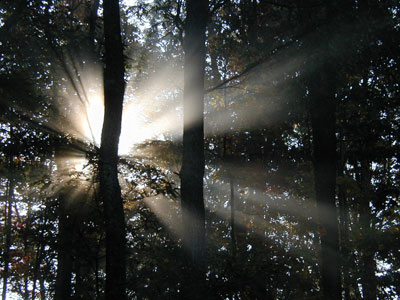
The sun is low in the sky and shadows are getting longer now. In the summertime the sun seems to jump up into the sky, and now it just takes its time and struggles to reach the peak of the summer sun. Try taking photos of sun streaks through the tree leaves to see some interesting patterns.

Sun shining low in the sky produces a starburst effect when viewed through the trees.

Sun shining low in the sky produces a starburst effect when viewed through the trees.

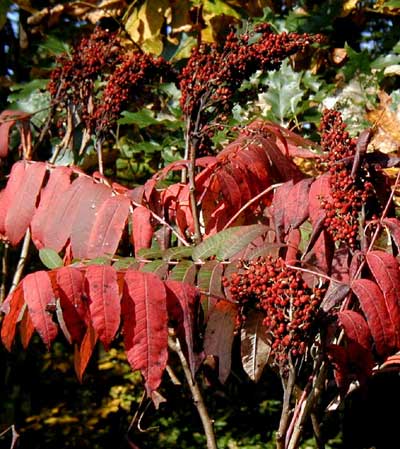
Smooth Sumac, Rhus glabra, are small trees found at the edge of the corn field and along the lane. This time of year the berries are bright red and so are the compound leaves. Sumac berries are a good food source for many types of songbirds as well as the pheasant, turkey and grouse.

Red berries hide among the bright red leaves of the sumac.

Red berries hide among the bright red leaves of the sumac tree.

Native Americans used sumac wood to make long peace pipes. The pith of a section of sumac wood can be picked, pushed or burned out to produce a hole than runs the length of the branch. The bowl and mouthpieces were inserted into the openings of the pipe and typically were removable for transport so as to protect each piece. Decorative carvings or paintings adorned the pipes.

Red sumac berries have been used to make a lemonade-like drink for many years. All you do is collect the group of berries and soak in cold water for about 15 minutes. Strain the pink liquid through cheesecloth, sweeten and chill.

You can use either staghorn sumac or smooth sumac berries as there are only slight morphological differences between these two Rhus species that sometimes hybridize.

Don’t worry, the red-berried sumacs are not like poison sumac, which has ivory-white berries that dangle downward and grows in swamp-like areas. Don’t touch any part of the poison sumac plant as it causes severe dermatitis - even worse than poison ivy!

Variety, the Spice of an Amish Farmer’s Market and Bakery

Posted on 5 October 2006 by wilde

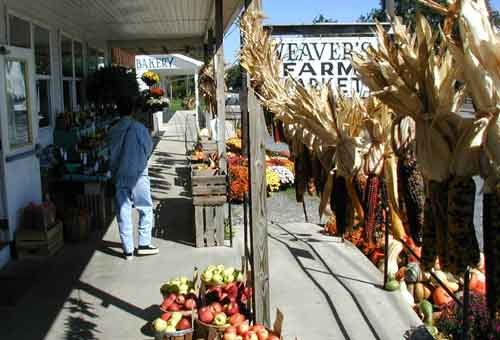
We’re in Amish country today. Just look around and you’ll see horses pulling buggies or carts. Youngins – always wearing hats – go most places on bicycles or on foot.

Farmers’ markets and their womens’ bakeries have something for everyone. What a delight!

It’s always fun to go to the local market when you’re traveling about. Here’s a great Amish market a few miles south of Selinsgrove, Pennsylvania. There are a couple places along this stretch of Routes 11/15 where you can purchase Amish-made quilts — just look for the quilts blowing in the breeze!

After viewing and purchasing some of the apples, pumpkins and other home-grown vegetables, we move on to the Bakery.

Guess where she's headed! Shoe-fly pie, anyone?

Guess where she’s headed! Shoe-fly pie, anyone?

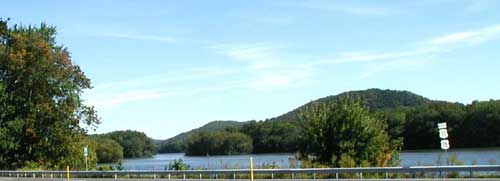
And who wouldn’t be delighted working across the highway from such a beautiful river front view?

The Susquehanna River as viewed from across Routes 11/15 at Weaver's Farm Market.

The Susquehanna River as viewed from across Routes 11/15 at Weaver’s Farm Market.

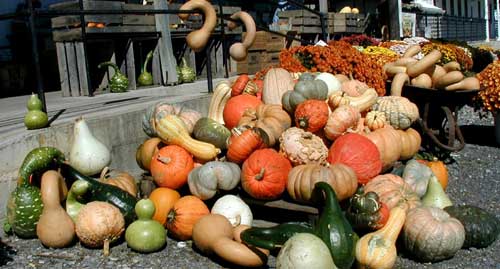
If variety is the spice of life, then it would be good to be a gourd! Check out the different colors and textures of these gourds.

Can't imagine using that old wheelbarrow for anything but a display!

Can’t imagine using that old wheelbarrow for anything but a display!

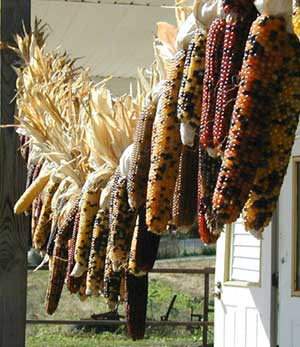
This Indian Corn tells the season, doesn’t it? The variety of colors makes it a great addition to seasonal decorations.

Indian corn hanging at the farmer's market.

Indian corn hanging at the farmer’s market.

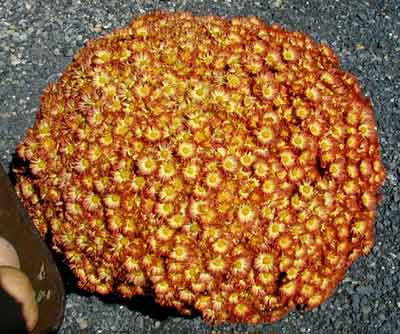
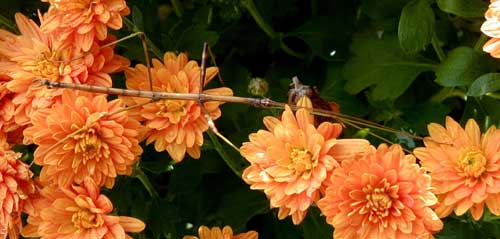
Talk about variety — Chrysanthemums are now available in so many colors. It would be a shame to not have at least one or two for a splash of fall color outside your doorstep. Look how many blossoms are on this mum — you can’t see any green!

Chrysanthemums are available in many autumn colors. This one has a multitude of blossoms.

Chrysanthemums are available in many autumn colors. This one has a multitude of blossoms.

In Zone 5 it’s a coin toss as to whether they will overwinter, but try planting a few mums anyway. They make for nice cut flowers that are fairly long lasting.