Some nicer pictures of the American elder and its clusters of white flowers.
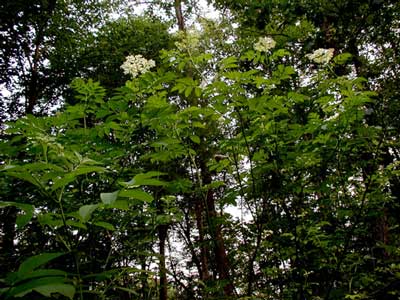
Shrubbery of the American elder tree.
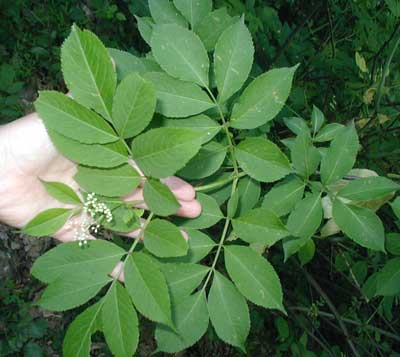
Elder leaves are compound with 5-7 leaflets.
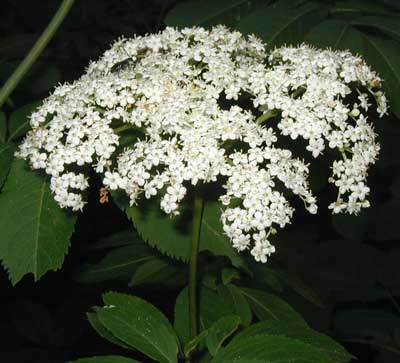
Closeup of an elder flower cluster.
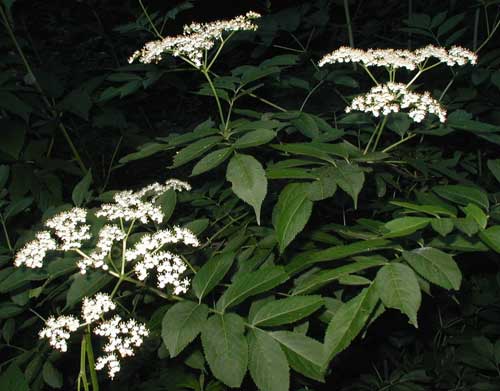
Clusters of elderberry flowers.
Here’s a nice grouping of the whorled loosestrife along the lane.
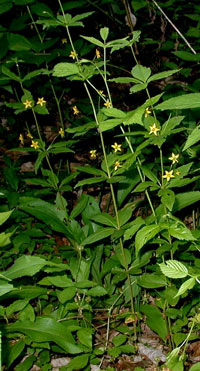
Several whorled loosestrife along the lane.
I’ve never eaten Poke, but people say it’s good greens — but only when young shoots are collected in early Spring. The mature leaves, roots and stems are poisonous. Pokeweed, Phytolacca americana, is quite noticeable as it has huge leaves!
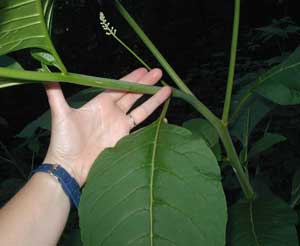
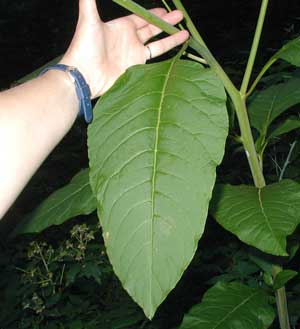
Pokeweed has huge leaves!
Poke flowers appear to have white petals, but those are actually the sepals. When the fruit ripens the cluster of shiny, purple-black berries hangs downward.
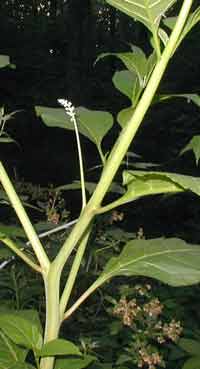
Tiny white flowers for a very large plant.
Another flowering plant we found along the lane is yarrow, Achillea millefolium, a member of the composite family, Compositae. The flowers appear in flat, tight clusters and are usually white and sometimes pink.
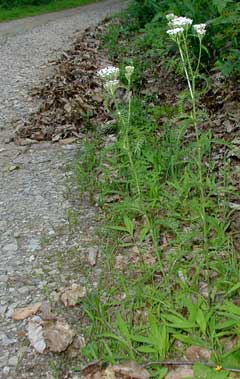
A couple yarrow plants alongside the lane.
Yarrow, a perennial, is distinguished from other similar-looking flowers by its greenery. The narrow leaves are finely divided and remind one of a fern. Yarrow leaves are aromatic, too.
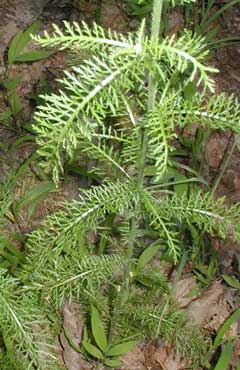
Narrow leaves with many divisions help to identify yarrow.
An interesting note about yarrow is that its use in folk medicine has been substantiated by the fact that over 100 biologically active compounds have been found in yarrow. A tea made from dried flowering yarrow is used for many maladies, including colds, fever, gastric upset, and internal bleeding. A poultice made from fresh leaves is styptic – used to stop bleeding. Indeed, legend has it that Achilles used a poultice of yarrow leaves to stop the bleeding of his soldiers’ wounds, thus the generic name Achillea. Caution: Do not use yarrow in any form if you are unsure of its identification as other similar plants are deadly poisonous, such as Fool’s Parsley and Poison Hemlock.
The tomatoes are in bloom in the vegetable garden, and the foxglove, statice, rudbeckia, tiger lilies and lamb’s ear are blooming, too.
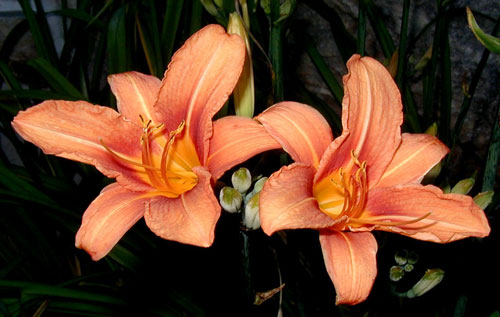
Tiger lilies blooming in the flower beds.
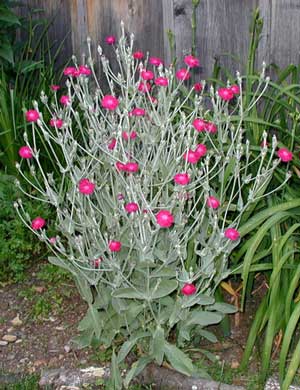
Hi there what kind of lambs ear is that in the photo thanks Alex
Hello Alex,
I tried to find out from my auntie who gave the lamb’s ear, but she didn’t know the particular variety of lamb’s ear. All I can tell you is that it’s the second year plant that flowers.
After this flowering quite a few volunteers sprouted up and formed basal rosettes that overwintered. The following year, if the rosettes have gathered enough energy, they send up the flowering shoots.
I’m looking forward to another flowering group of lamb’s ear this year. If they do, I’ll post some pics because the photo above doesn’t show the vividness of the bright blooms.
That is Rose Campion in the photo. It will reseed from the stalks all over the place, but it is great if you don’t have a formal yard or garden.
Common names can really confuse things, can’t they?
Rose Campion, Lychnis coronaria, and Lamb’s ears, Stachys byzantina, have similar silvery foliage and seem to have the same habit of re-seeding themselves everywhere. I can vouch for the former, as we now have many small silvery rosettes of the rose campion all around the area where it flowered two years ago.
Also called Mullein Pink, the Rose Campion is a member of the Pink Family.
Thanks for the tip, Debbie!
that is correct… this is not Lamb’s Ear. It is known as mullein pink, rose campion or Bloody William.
Another common name for this prolific plant! Didn’t hear the ‘Bloody William’ tag before, but I think I like Rose Campion better.
It certainly IS prolific – we have tons of rosettes from last year pushing up over a foot tall now. The blossoms will be out soon and I’ll get a few more pics then.
Glad you chimed in here, Dixie!
I am so happy to finally find the name of these beautiful flowers. we bought a house two years ago and they are growing all over the place.
I am so happy to know what that flower is
I am sorry that this is not really a comment but I am really needing some help. Please can you help me to identify this plant or weed. It grows to approximately 6’tall and have large shiny black berries that are very juicy. The berries are singular and are approximately an inch in diameter in large open leaves. The stems are hollow and are singular also. They come from the ground in a cluster and grow straight up. The root is huge and in the form of a tumour much like a parsnip but much fatter and can branch out also.
I need to know as there will be lots of children around in this garden and I want to avoid problems I have cleared them temporally to avoid it but they will grow back and I want to know what I am dealing with. Thank you for your time.
Belinda
Belinda,
If you could possibly send a picture, we’d have a better chance at identifying your plant. Aside from that I think you did right in clearing the tempting berries from an area where children will play. Of course we won’t eat anything that isn’t definitely identified as food! Any thorns or prickles on the stems? What shape and size are the leaves?
Good luck in your search!
All these plants are in bloom right now in CT. Everything is 2 weeks early this year, even the strawberry crop. Seeing your photos looks like a walk around my yard and woods right now. 🙂
Hey Christine,
In central PA we have the same flowers blooming now this year. The elderberries are fading a bit, but the rose campion and day lilies are going strong!
Enjoy those strawberries!
I would like to send you some pictures of a large impressive pretty looking plant with “pink flowers” One which is growing in a green house( Self set) has leave 24 inches long. one outside in garden not quite that big. I have been told this is Poke weed but of all the pictures I have seen on the net very few come any where near this plant. I would love to E Mail them to you and see if you could Identify the species as i have grave doubts about the presant identifaction. I dont wnt to keep it in the garden/greenhouse ifits a potential dangerous or toxic plant Problem! cannot find your e mail address or any means to attach the picture to this post. Yours Faithfully E Exton Mr.
Hello Mr. Exton,
I would certainly try to identify your mystery plant. I’ve emailed you so you can send me your photo. What you’ve described doesn’t sound like pokeweed, so you’ve piqued my curiosity. Hope to hear back from you.
hello my name is ivan I’m Dominican and when you took that small plant (elder) is very good as I can get live in Manhattan
where I can find the plant or leaf elder tankyou
Hi Ivan,
I enjoy taking photos to share of the wild plants that I find and use. What do you use the elder leaf for?
Ivan,
We use the elderberries that we know grow locally, so I have to admit that i haven’t purchased any for consumption or planting.
Try the golden elderberry, it looks beautiful in bloom.
Organic, dried elder flowers, elder berries and liquid extracts might be of interest.
I believe this mystery plant is poke weed.
Hi Jon,
If you were referring to Belinda’s comment, “…berries are singular and are approximately an inch in diameter”, it can’t be pokeweed. Poke weed has several berries in a cluster, so they’re not singular. Also, each berry grows to about a quarter-inch in diameter, not an inch.
Were you commenting on something else?