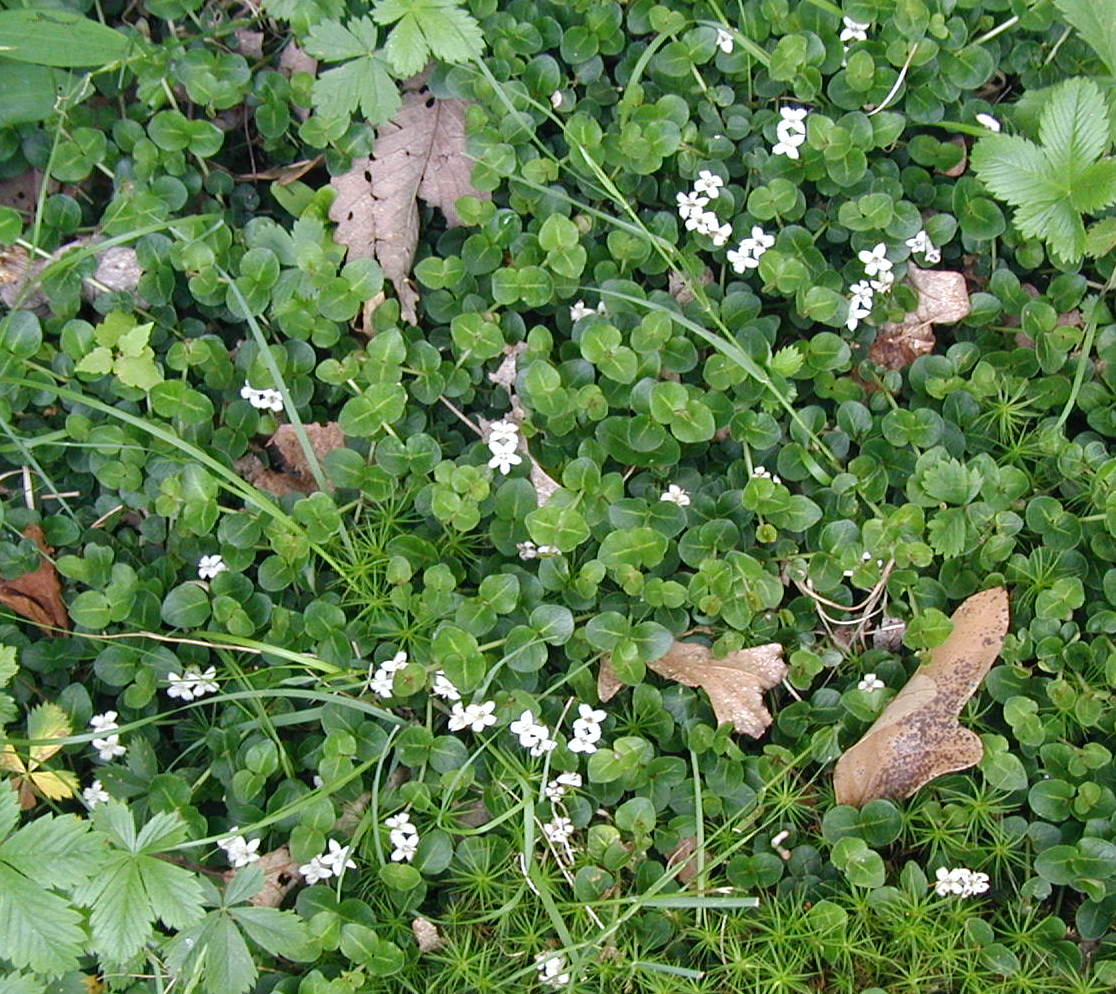
Partridgeberry, Mitchella repens, is a member of the Madder Family, Rubiaceae. It’s one of the plants that just make me think, “Forest Flowers.” You won’t find it growing anywhere else but in a forest or perhaps in a shade garden. Partridgeberry is native to the Eastern North America.
The terminal white or pink trumpet-like flowers are fragrant. The four petals are fuzzy-looking due to hairs on the inside of the petals. Twin flowers seem to be connected at their bases by a common stipule.
Small, rounded opposite leaves and twin flowers of partridgeberry.
Stems are creeping with small, opposite, leathery, round evergreen leaves. Leaves usually have a light-colored midrib and sometimes the other leaf veins stand out with a lighter color. Leaves are otherwise dark green and entire, or untoothed.
Low-growing partridgeberry with its twin flowers.Partridgeberry on the forest floor with old oak leaves. Photo taken 3 June 2010.
Twin flowers coalesce into a single red berry that may last through winter and remain at the tip of the vine until Spring. Peterson’s Edible Plant Guide tells us the berry is edible – it just doesn’t taste like anything. The tasteless berries can be used as a survival food or added to salads for a bit of color.
Partridgeberry does seem to have medicinal properties. A leaf or berry tea was used historically for treating female problems, such as irregular or painful periods and childbirth pain, which lent partridgeberry the nickname Squaw Vine. Astringent qualities of the tea led to its external use for skin irritations and as a wash to soothe arthritis.
About five years ago we went to a Native Plant Sale held at Millersville University, Lancaster County, PA. We picked up two native plants, Wild Ginger and Spiderwort, Tradescantia virginiana.
Wild ginger is much more plentiful in the wild, at least in the places we’ve looked. The wild ginger we planted has spread out a little bit and the original plant carried its flower from earlier this year until the second week of June. Spiderwort flowers beautifully in the later part of May into June.
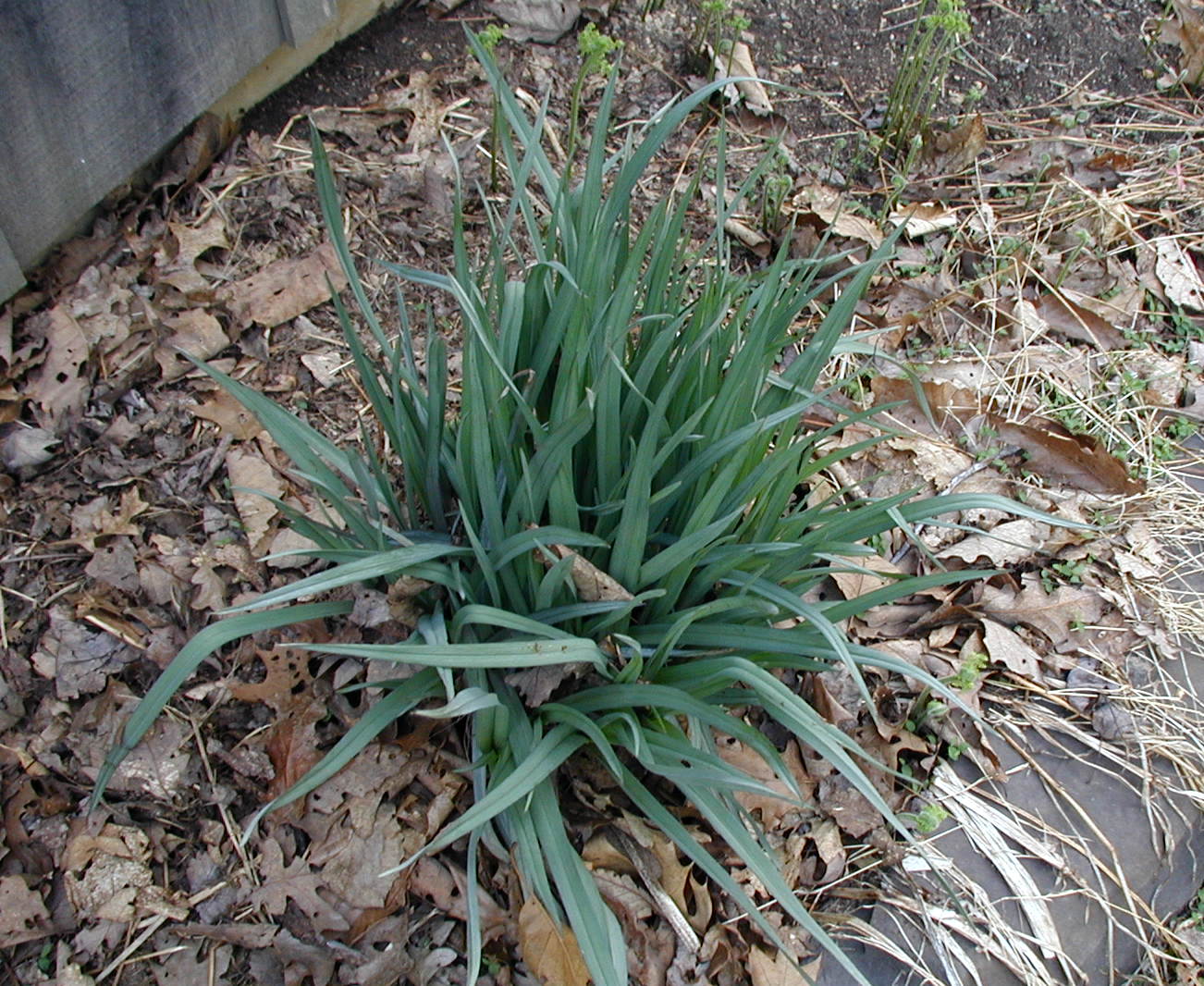
Greenery of the spiderwort plant rises up early starting in April. Photo below taken 11 April 2010.
Leaves of spiderwort are already up 8-10 inches.Spiderwort greenery getting taller.
A couple of weeks later (23 April 2010) the foliage is over a foot tall. The linear leaves arch over as they get taller. It will take 2-3 weeks from this stage for the spiderwort to start blooming. Check out how small this spiderwort plant was in 2006.
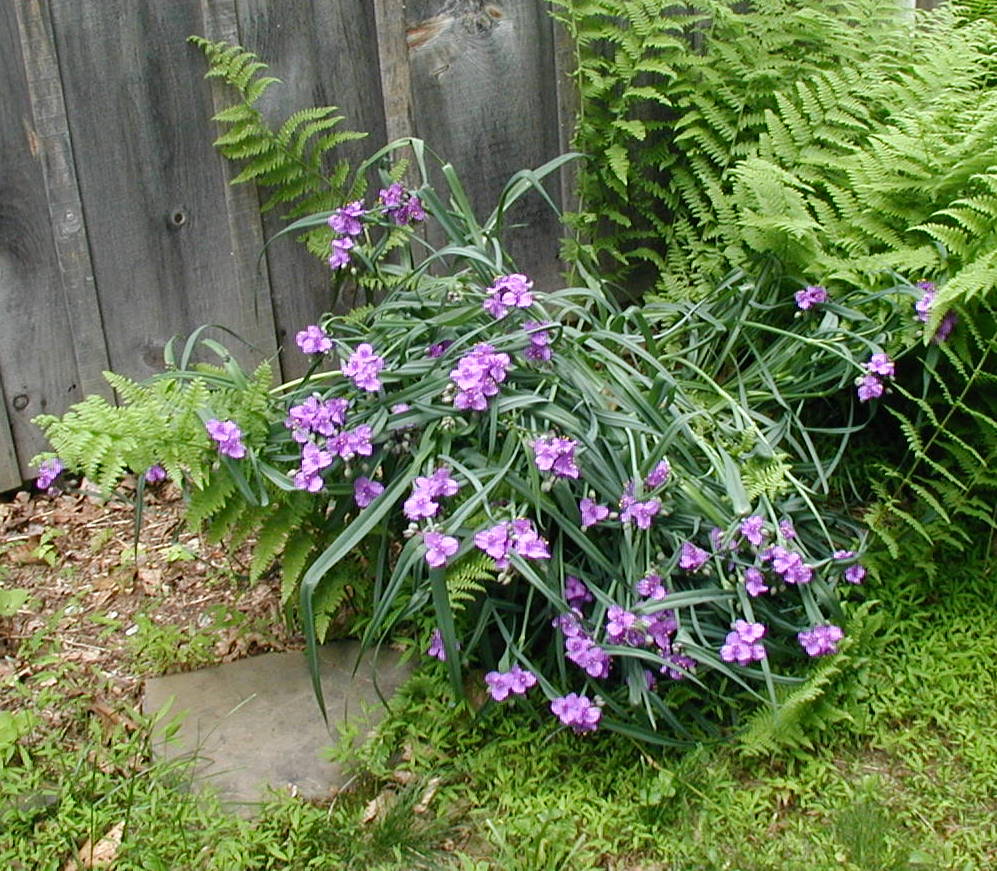
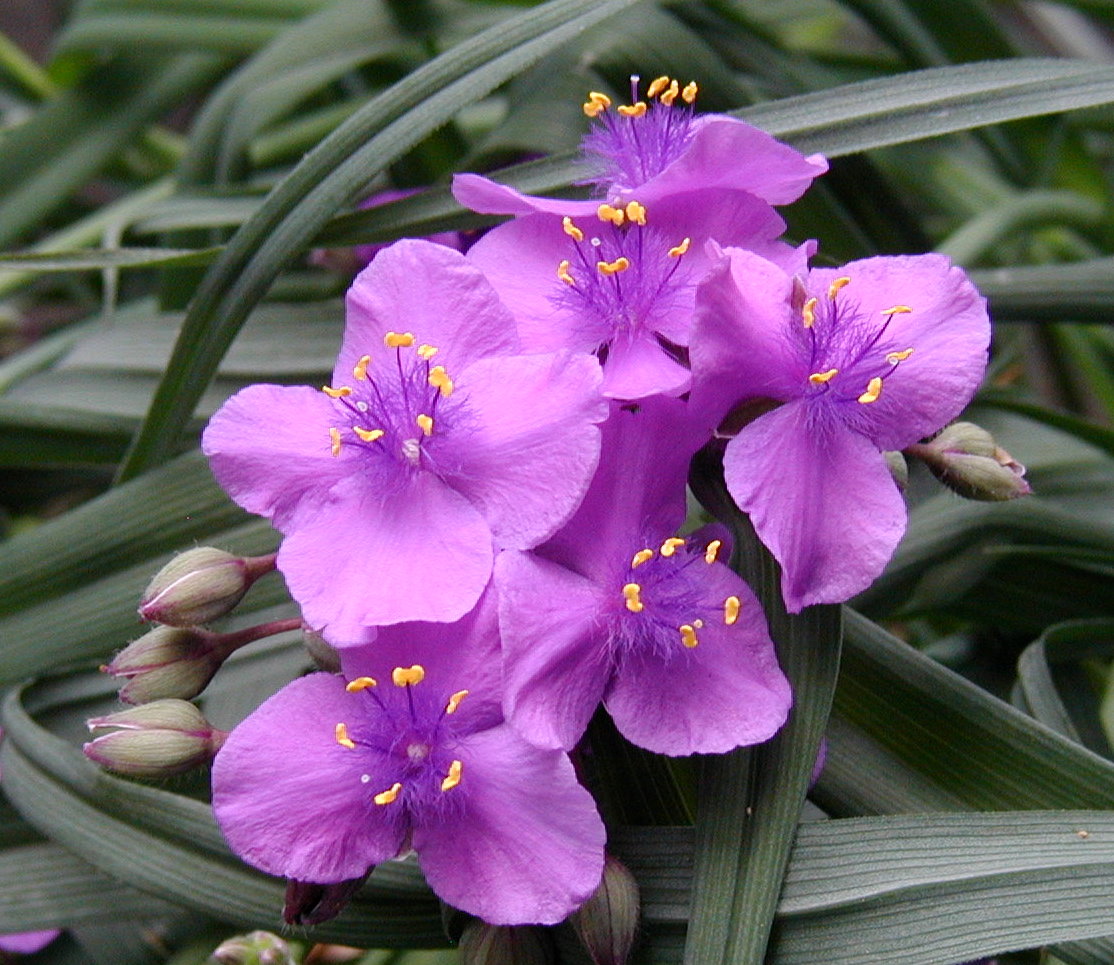
Many purple-blue flowers of spiderwort.
This year I should have staked up the plant as it got heavy with blooms and now is laying over to the side. The flowers are still really pretty!
Heavy blooms of spiderwort made the flower stems bow down to the ground.
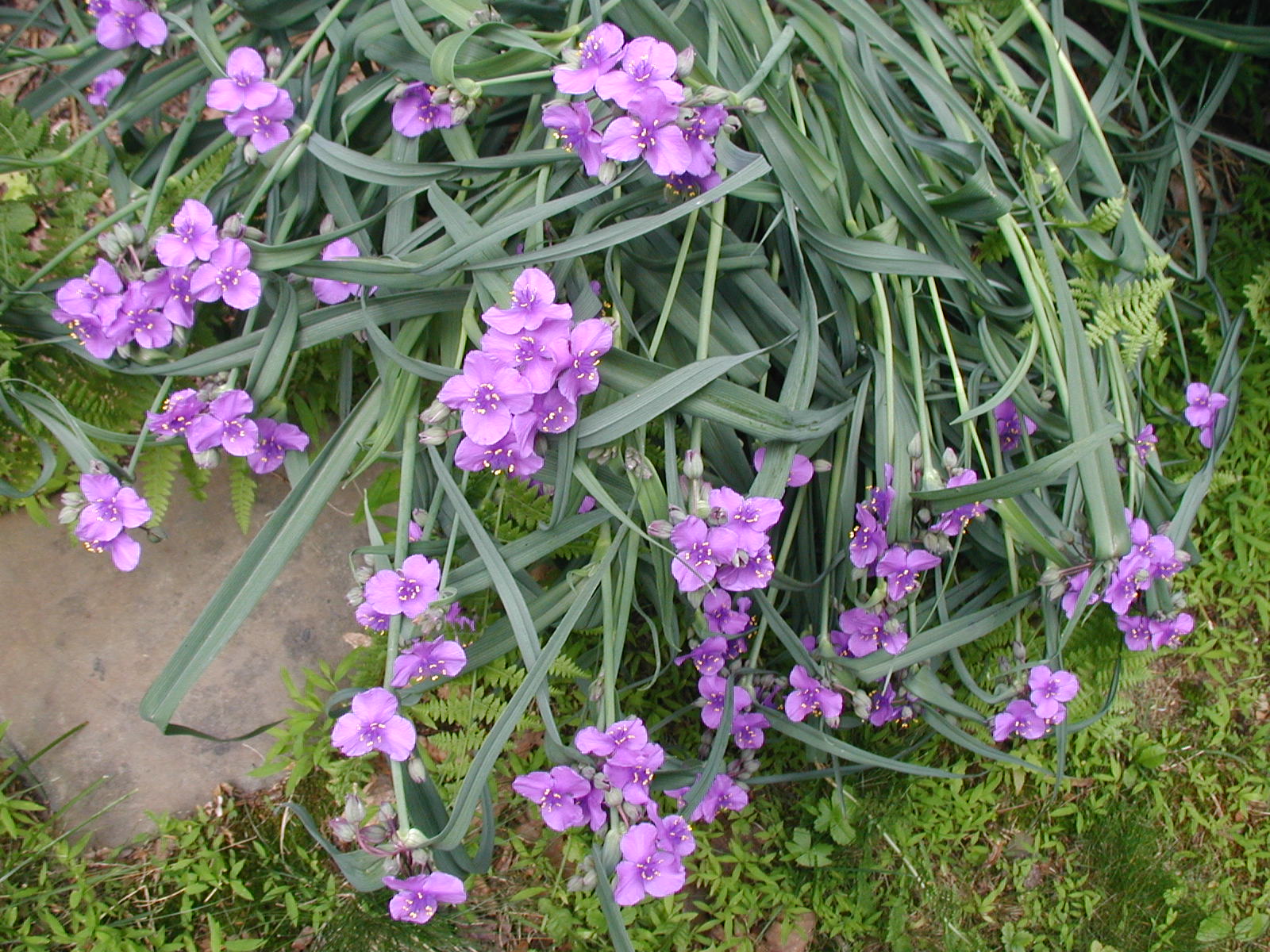
Didn’t get flowering pics until 31 May 2010. Spiderwort flowers were blooming until 11 June for a 2-3 week blooming period for 2010.
Younger plants may have fewer flowers open at one time. Each bloom lasts for a day and then only in the morning. The blossoms wilt and turn to jelly by mid-day.
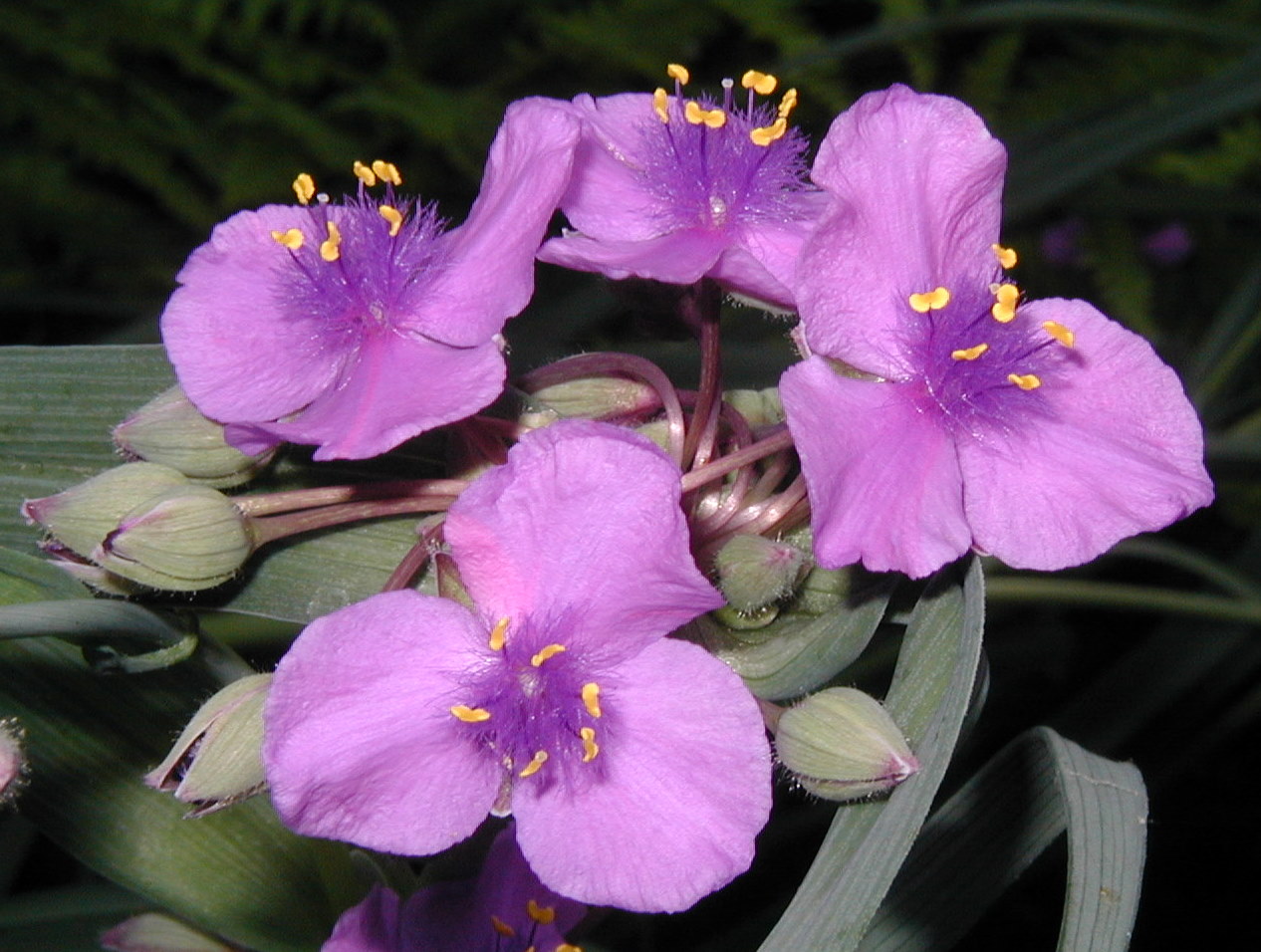
Note the stamens with golden-yellow anthers, fuzzy purple hairs, and the flower pistil with a round end or stigma in center of bloom. Note that the lower left flower has four petals instead of the typical three – only saw one flower with four petals out of about 80 blossoms. Click on any of these photos for a larger view.
Purple spiderwort flowers are hairy in the center.Beautiful spiderwort flowers!
The flowers are so pretty that people used to make them into candy. Peterson’s Edible Plant Guide says all you have to do is rinse the flowers with water, dry gently, brush with egg white and coat with sugar. Not sure the effort would be worth the taste, but at least they’d be real pretty!
A few years ago there were only a few ferns on the north side of the house. The ferns are plentiful in the adjacent woods, but there they do not form mats. The forest ferns rise up in a ‘singular’ fashion and the fronds are not all bunched up in a large grouping.
Hay-scented ferns growing singly in the forest.
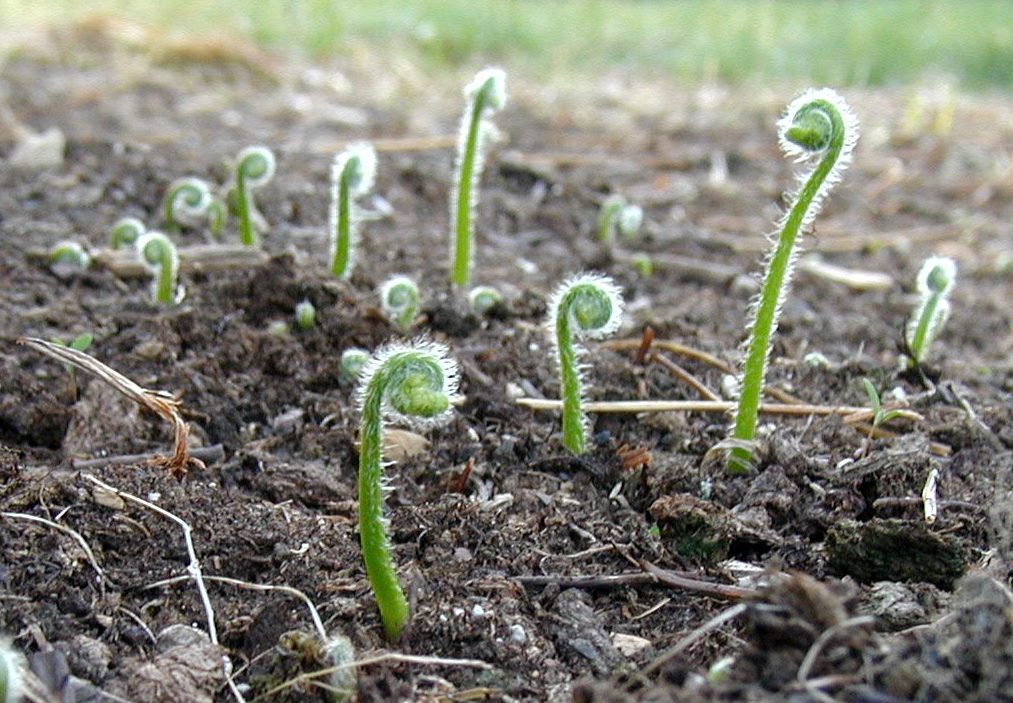
Ferns come up in early April as they slowly unroll their long fronds. Each frond starts out rolled up in fiddle head fashion.
Fiddleheads rise up out of the earth.Unrolling fern fronds.
Photo above taken 11 April 2010.
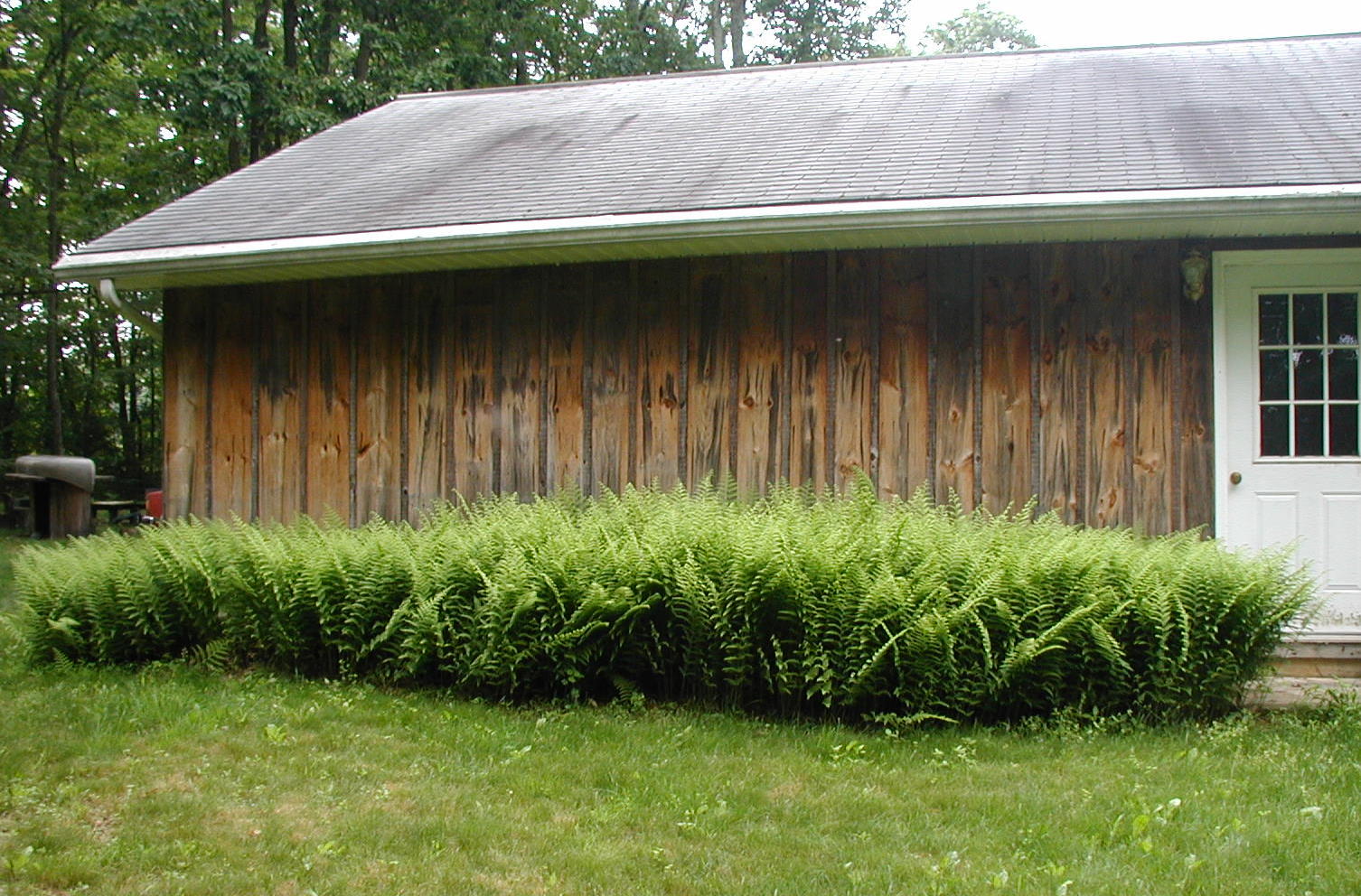
At the back of the garage the ferns numbered a few on the left and the right side was empty. As the years went by the ferns spread out in both directions, further away from the building and further to the right.
Lush ferns growing on the north side of the garage.
Photo above taken 31May2010.
The original patch of fern was a few feet wide and perhaps three feet deep. Seven years later the ferns have taken up the entire width of the garage, about 20 feet wide, and the patch is a good six feet deep.
(I hunted for a pic of the small early patch of ferns, but no luck.)
This patch is now thick with fern fronds. As the ferns came up this Spring the area wasn’t raked of leaves or anything and the ferns sprouted up the thickest we’ve seen them.
Ferns on the north side of garage filling in.
Photo above taken 2 May 2010. I found it interesting that the ferns that grew the biggest first were the fronds right next to the house and the fronds furthest from the house. This probably signals that the growing ends of the roots are the strongest, and therefore, the first to take advantage of a new growing season.
In the woods these ferns are in more of a singular fashion. Several fern fronds will be in the same area, but they tend not to occur en masse, at least at this location and time. If left alone the Hay-Scented Fern, Dennstaedtia punctilobula, would probably create a near monoculture like what you see behind the garage.
We have a few different kinds of ferns on our land here in South-central PA. The hay-scented fern seems to be the most prolific. We see it in the most places and there are more of them compared to the other ferns.
Hay-scented fern, although it is native to North America, can be invasive. Judging by the thick growth at the back of the house, it’s easy to see that under the right conditions this plant could be a pest. Having said that, I do really like the fact that the ferns are perennial and come up to fill in the length of the garage year after year.
Clover is one of those plants that we all learn about growing up. Even if you are an urban dweller chances are high that you’ve seen clover in a yard, field or park. The common white and red clovers are ubiquitous, meaning they occur nearly everywhere in the world. Crimson Clover is native to Europe and introduced in the United States. With over 300 species of clover, there’s bound to be a few in your neighborhood.
Red clover and white clover have been blooming at the roadsides and in fields and yards around here for at least a few weeks. White clover seems to start its flowering before red clover. We most often see red clover in fields and by the roadside. Both will sprout again after being mowed, and they’re highly nutritious crops for livestock.
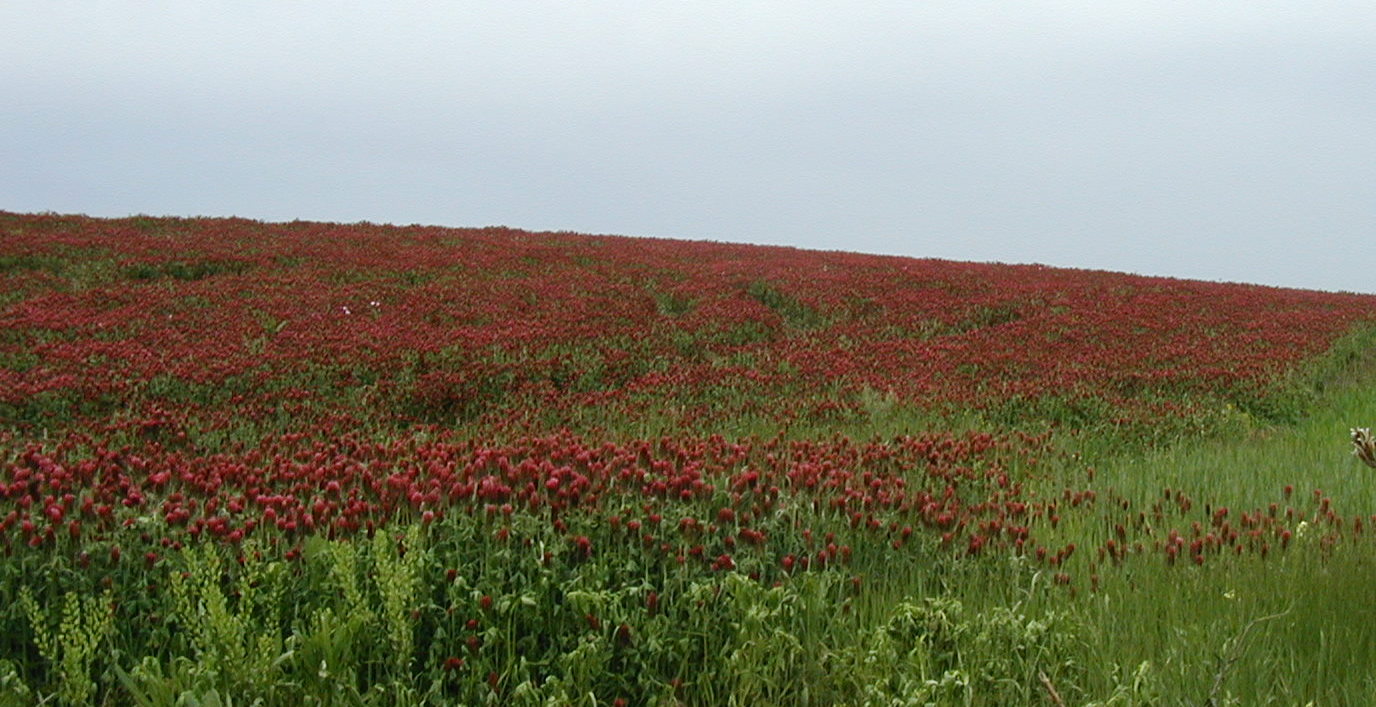
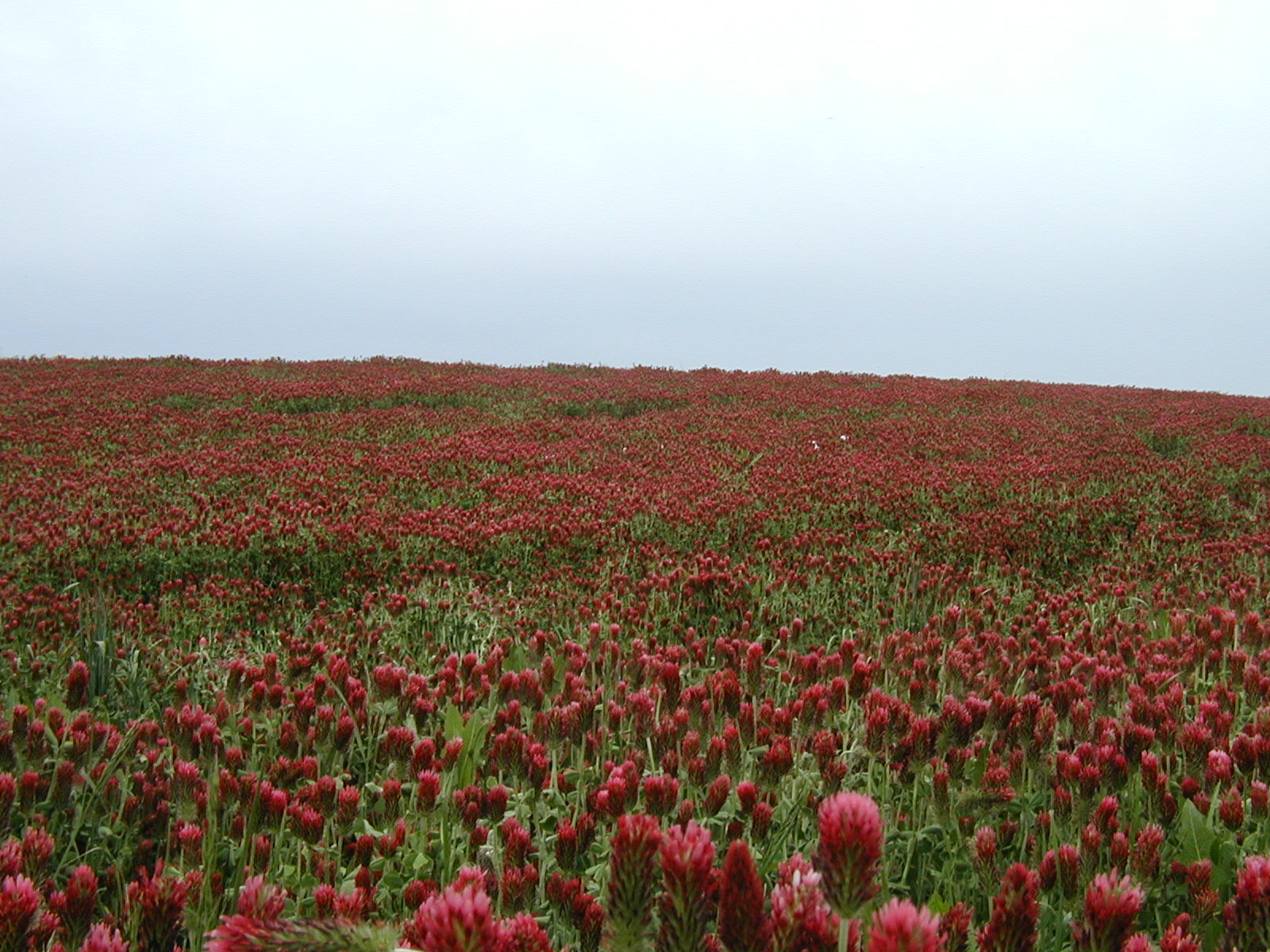
I always wanted to see some Crimson Clover up close. This year I got my wish as a neighboring farmer planted a whole field of it!
Field full of Crimson Clover.
The crimson clover field was harvested the week after these photos were taken on 17 May 2010.
Crimson clover as far as the eye can see.
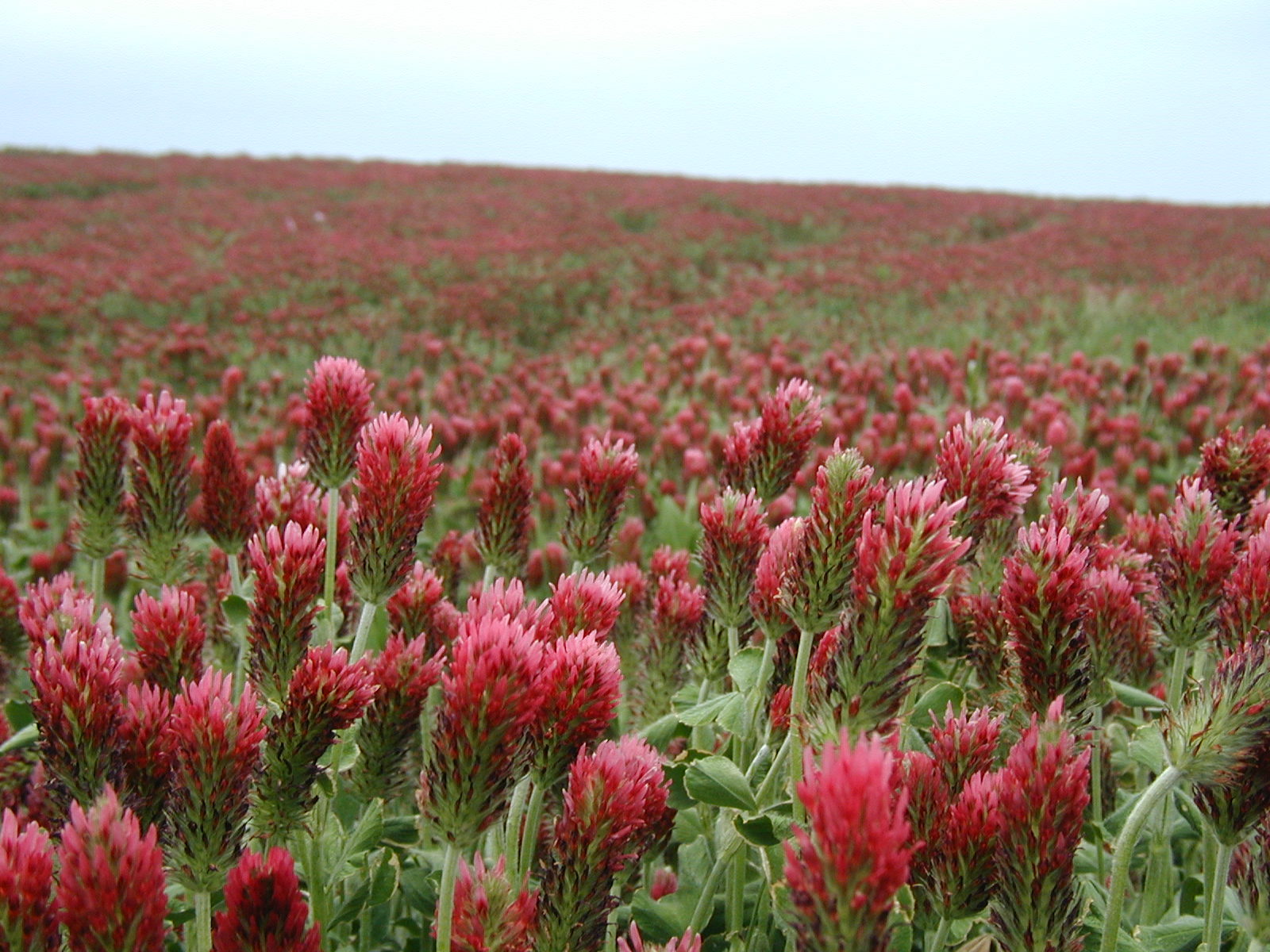
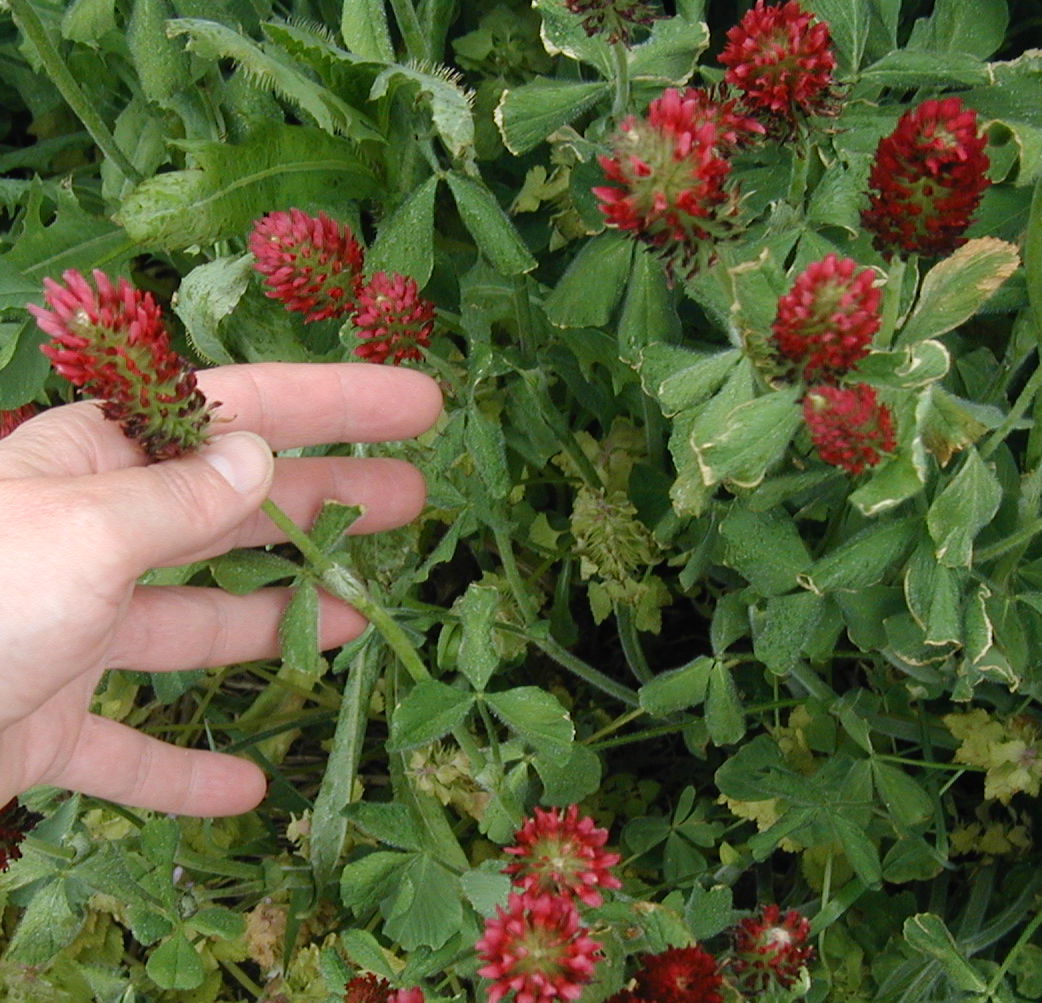
Crimson clover, Trifolium incarnatum, attains a height of 15-20 inches with a 1-3 inch long crimson head of flowers. Like all clovers the leaves occur in threes and are referred to as trifoliate. Note the genus name, Trifolium.
Trifoliate leaves and red heads of crimson clover.Crimson and clover, over and over!
17 May 2010
..red clover in field
Clover is one of those plants that we all learn about growing up. Even if
you are an urban dweller, chances are high that you’ve seen clover in a
yard, field or park. The common white and red clovers are ubiquitous,
meaning they occur nearly everywhere in the world. With over 300 species of
clover, there’s bound to be a few in your neighborhood.
Red clover and white clover have been blooming at the roadsides and in
fields and yards around here for at least a few weeks. White clover seems
to start its flowering before red clover. We most often see red clover in
fields and by the roadside. Both will sprout again after being mowed, and
they’re highly nutritious crops for livestock.
http://en.wikipedia.org/wiki/Clover
I always wanted to see some Crimson Clover up close. This year I got my
wish as a neighboring farmer planted a whole field of it!
clover-crimson-field1.jpg
The crimson clover field was harvested the week after the photos below were
taken on 17 May 2010.
clover-crimson-field2.jpg
Crimson clover, Trifolium incarnatum, attains a height of 15-20 inches with
a 1-3 inch long crimson head of flowers. Like all clovers the leaves occur
in threes and are referred to as trifoliate. Note the genus name,
Trifolium.
clover-crimson-leaves.jpg
Trifoliate leaves and red heads of crimson clover.
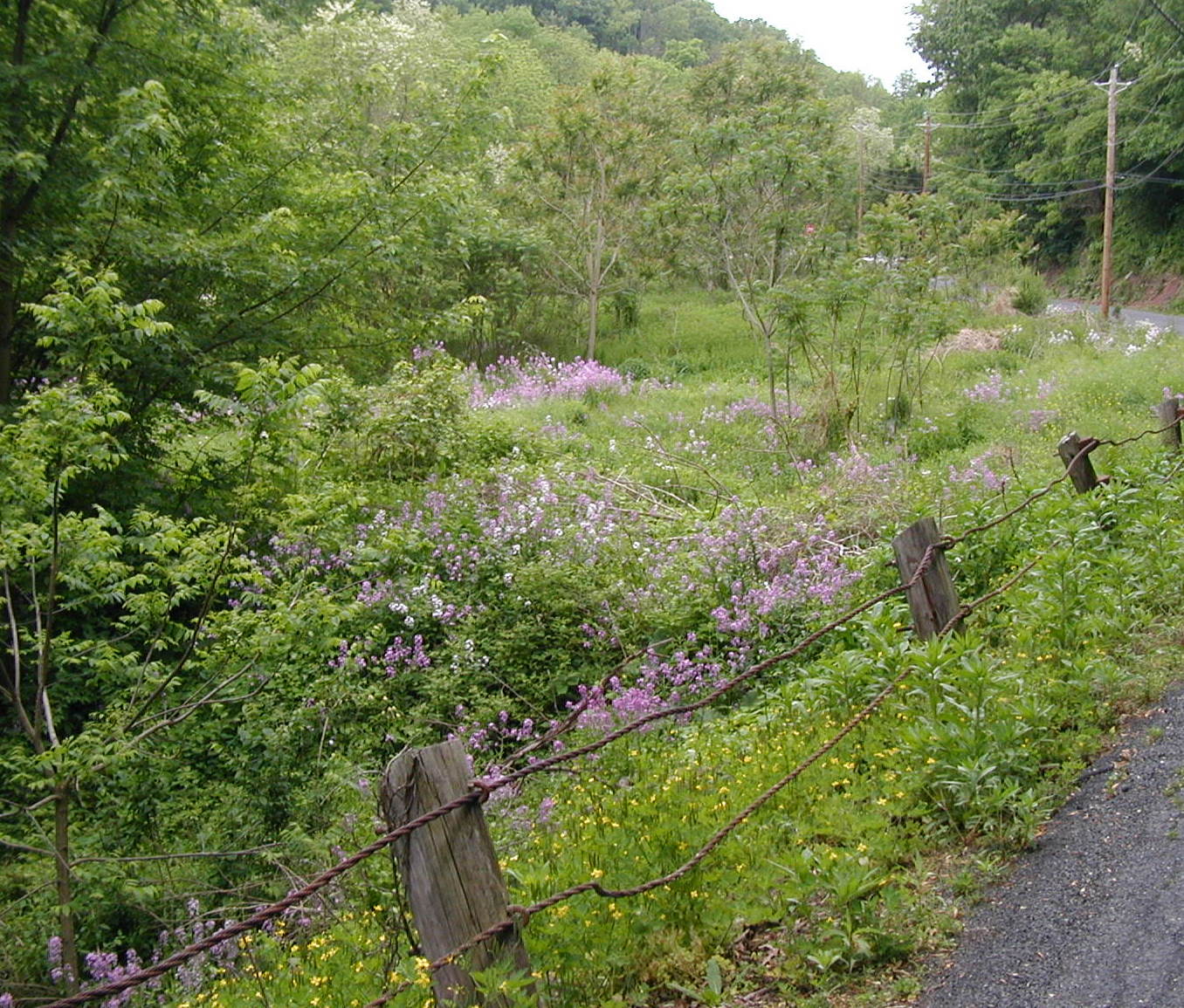
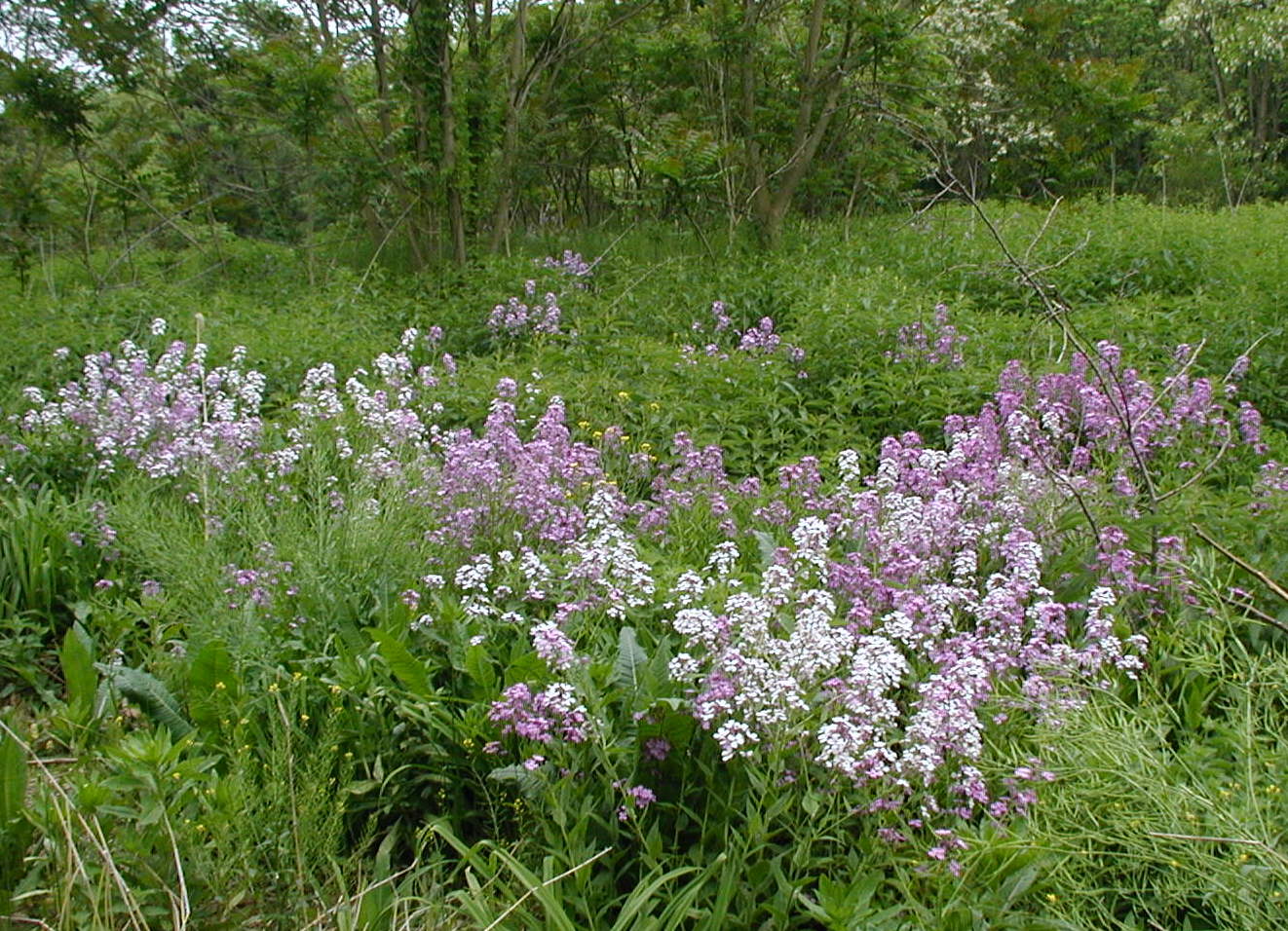
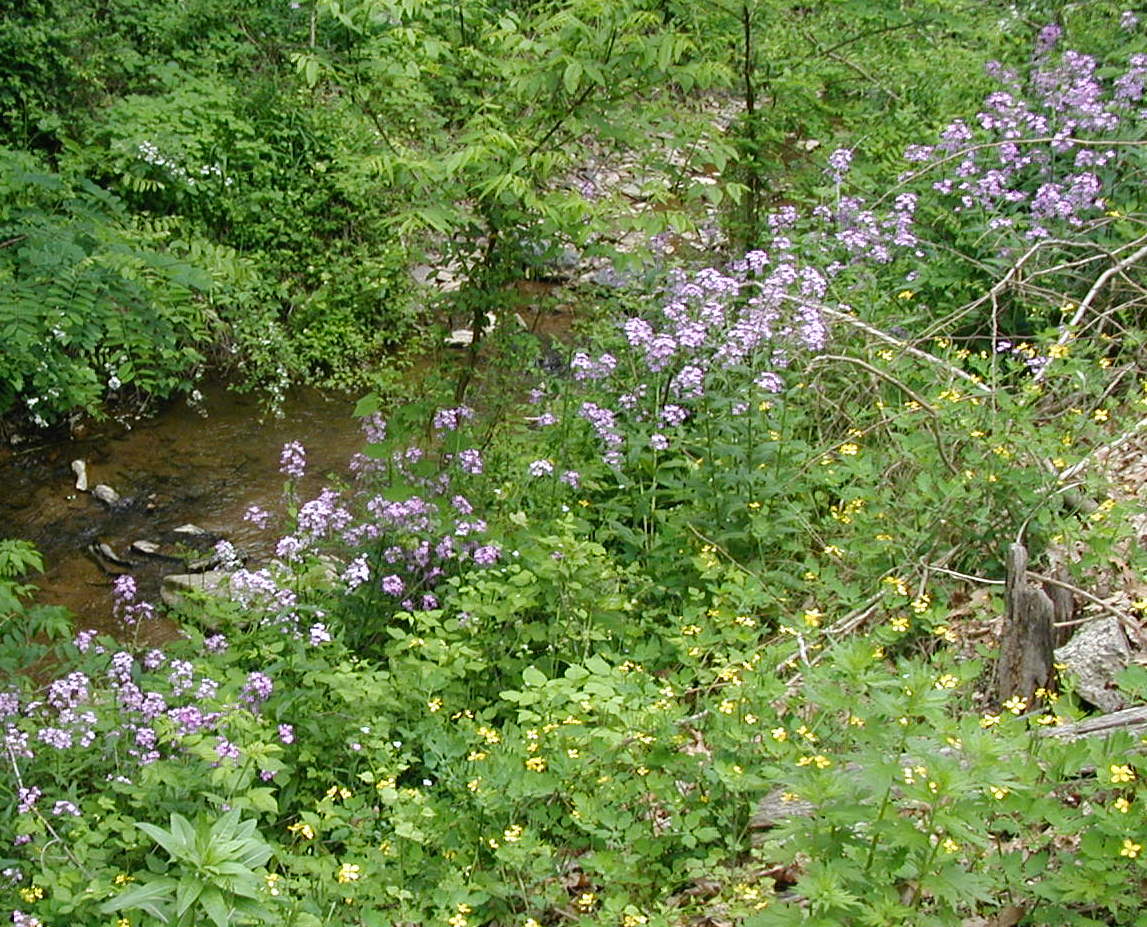
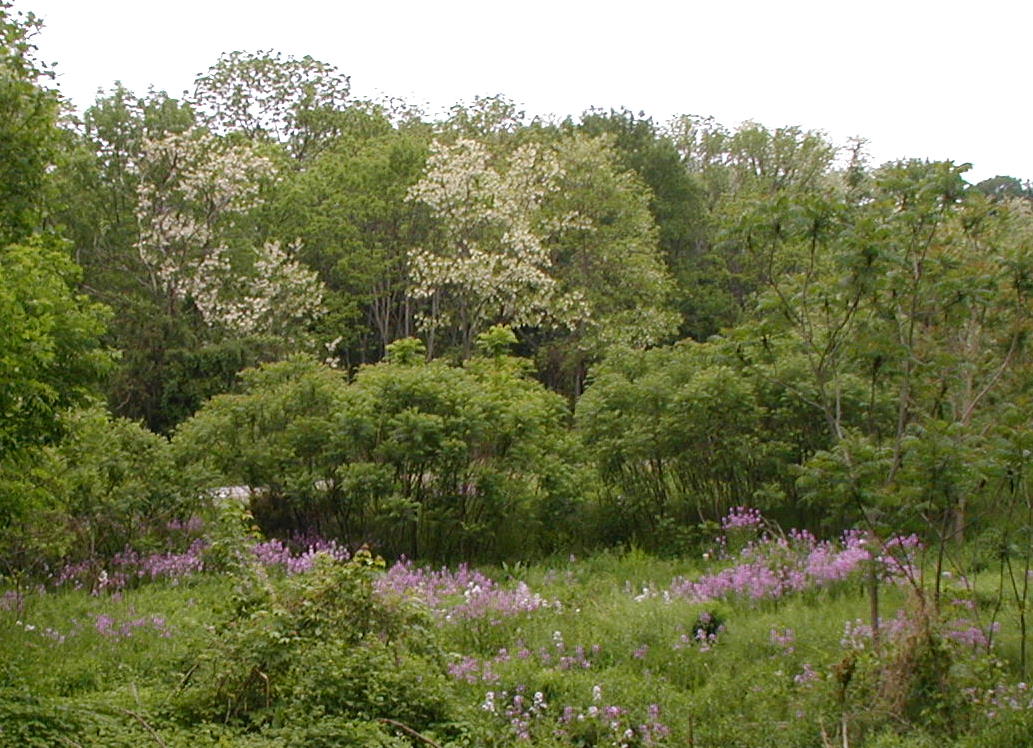
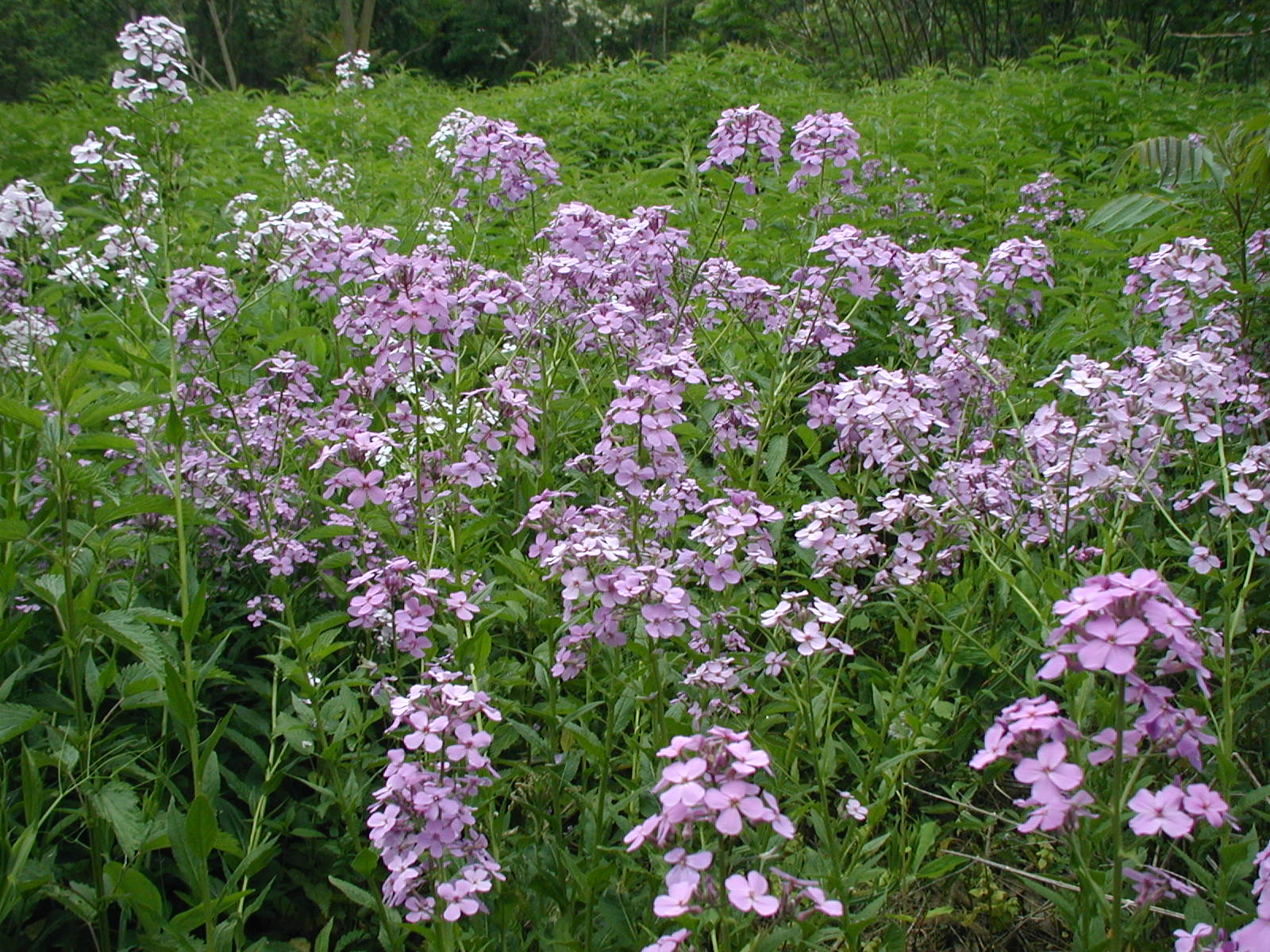
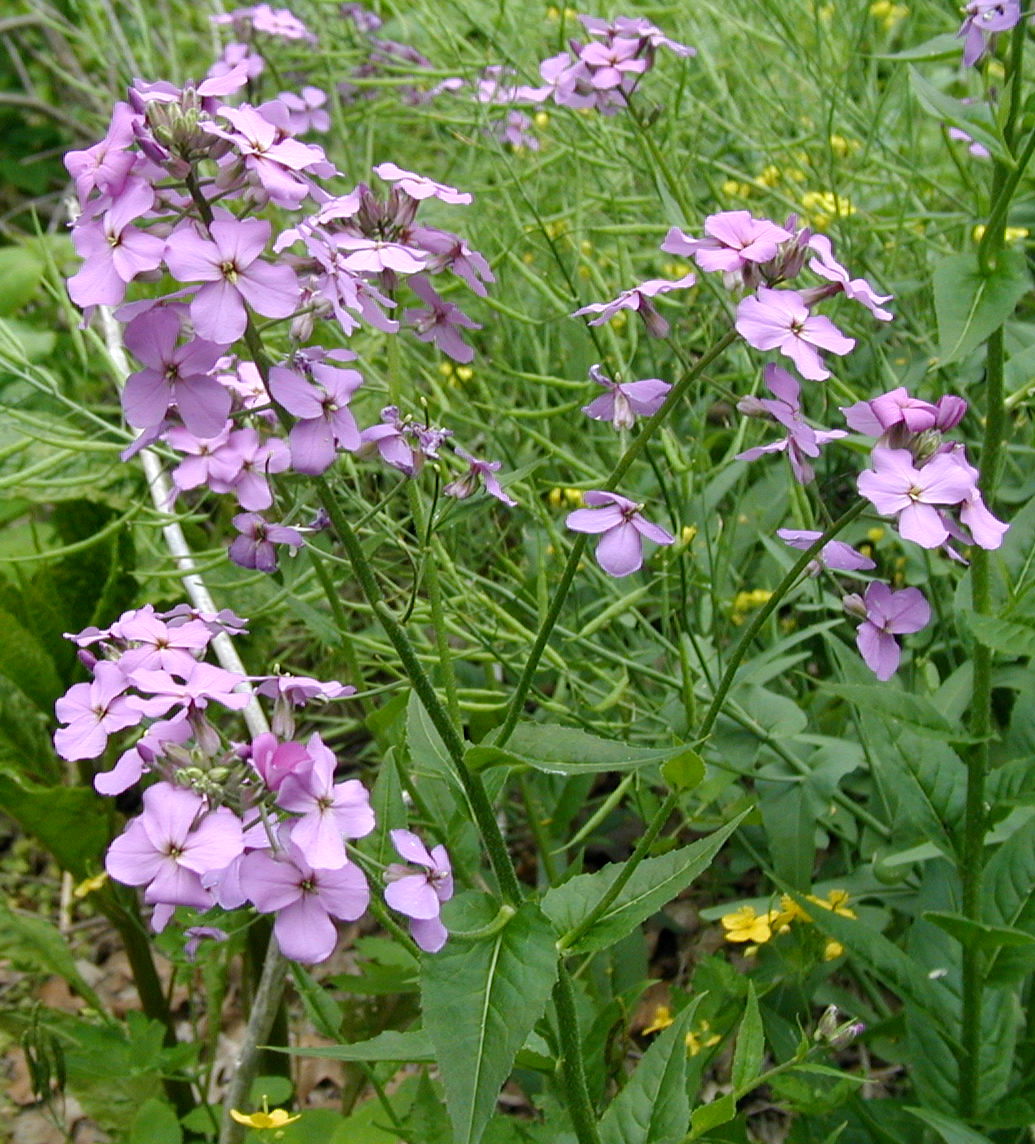
May’s beautiful colors were highlighted in the country by the large swaths of pink, lilac, purple, and white flowering Dame’s Rocket, a.k.a. Dame’s Violet, Hesperis matronalis.
Four-petal flowers cluster in terminal spikes at the top of three feet tall stems. For a two or three-week period in May Dame’s Rocket will be blooming in South-central Pennsylvania.
Great patches of purple and pink colors from Dame's Rocket flowers.Dame's Rocket blooming in waste area between two roads.Dame's Rocket on slope above drainage culvert.Flowering above a culvert with celandine.Dame's Rocket flowering at the edge of woods with locust trees in bloom.Group of purple flowering Dame's Rocket.Spreading purple clusters of Dame's Rocket.Flowering stalk with alternating leaves and four petal flowers.
Dame’s Rocket seems to prefer shady areas near the tree line or at the edge of the trees where the forest meets the road. The ones photographed above were growing in a waste area in between a two lane road and a highway access road.
Native to Europe and Asia, Dame’s Rocket was brought to America hundreds of years ago for its beautiful flowers. It has since escaped gardens to become naturalized in the Eastern U.S. where it is often seen in fields and near roads. It has been so successful that three states consider it invasive. Colorado has it on its B list of noxious weeds, Connecticut has banned it, and Massachusetts has prohibited it.
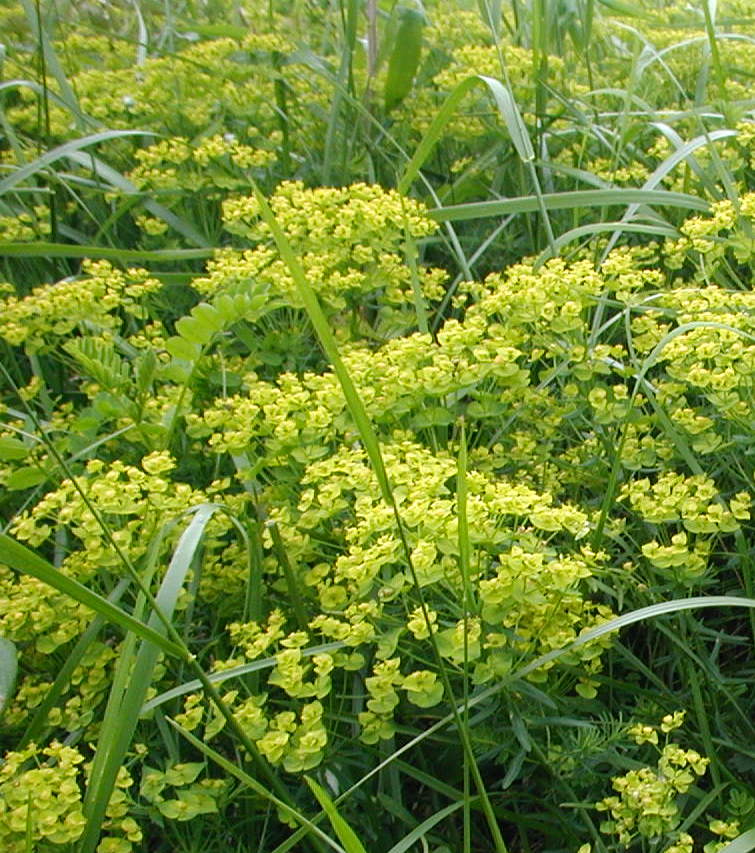
Every year we see what appears to be yellow-green flowers at the roadside right next to a small cemetery. These curious plants come up every year on the slope of the hill going up to the cemetery.
Yellow-green plants on hill at cemetery.Roadside view of yellow-green plants.
I finally stopped to take a closer look this May. The yellow-green flowers cluster at the top of the stem.
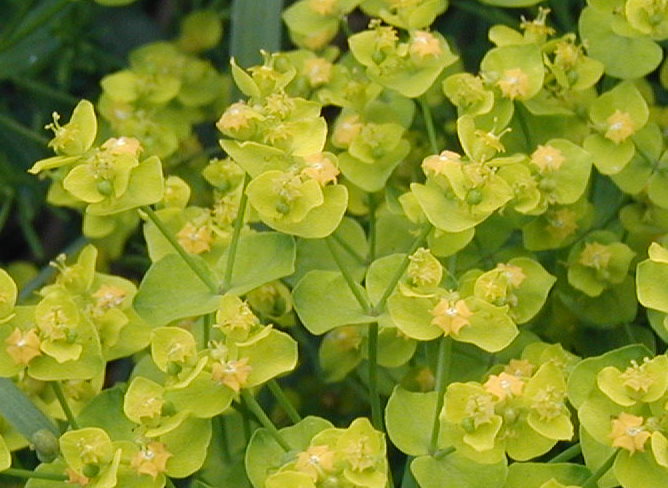
Clusters of Cypress Spurge flowers.
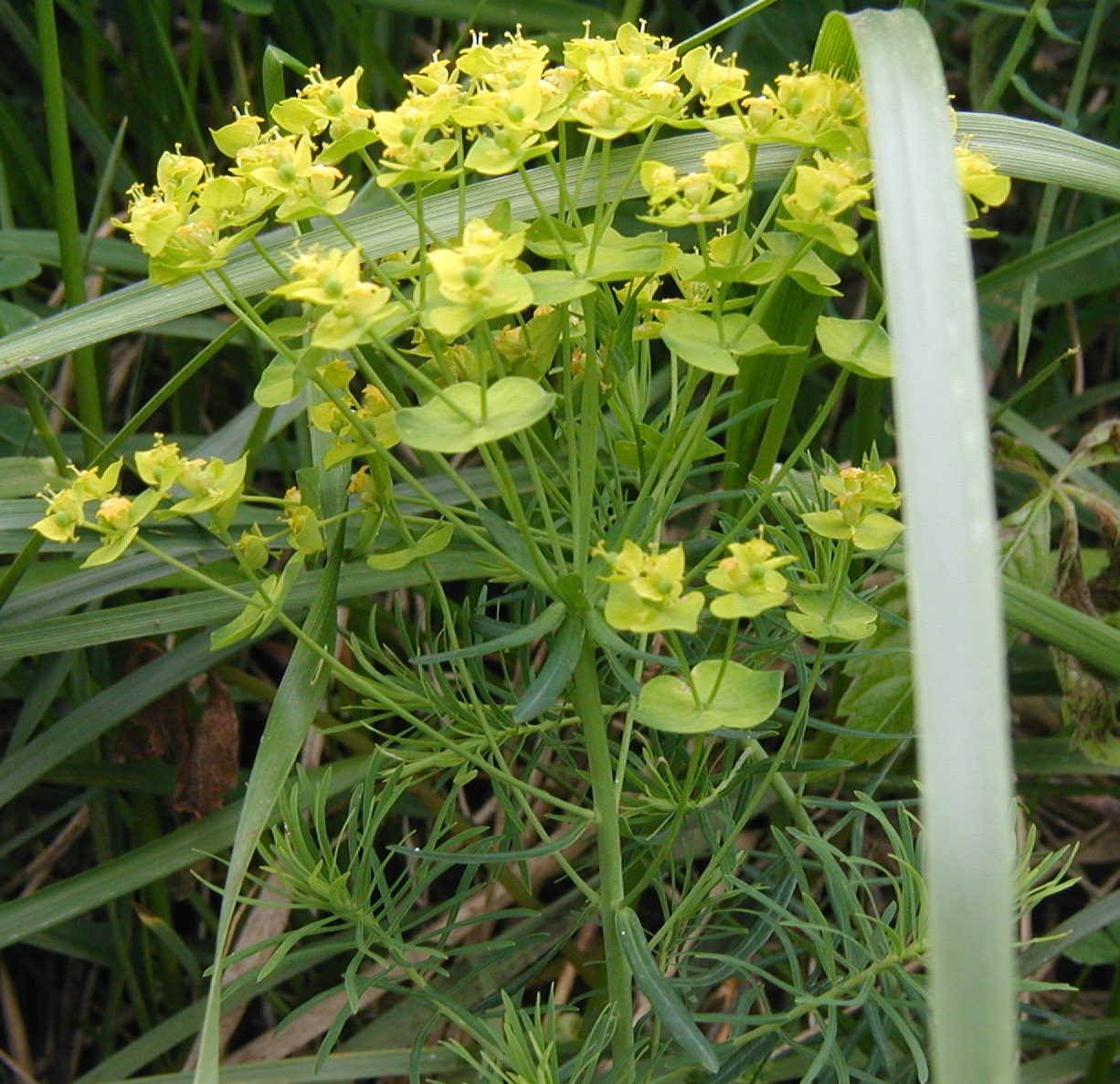
The many linear leaves alternating up the stout stem are characteristic of Cypress Spurge, Euphorbia cyparissias. Just underneath the flower cluster is a whorl of slightly longer leaves.
Linear leaves under the yellow-green cypress spurge flowers.
Note the many stem leaves and whorl of leaves at the base of most of the flower stems.
What appears to be yellowish-green petals tied at their bases are actually bracts. The flowers have no petals or sepals and are very small, less than 1/4 inch wide.
Close look at the inconspicuous flowers of Cypress Spurge.
A roadside alien from the Spurge Family, Euphorbiaceae, Cypress Spurge grows in waste areas, such as roadsides, vacant lots, and in this case, near a cemetery. I found it curious that Peterson’s Wildflower Guide mentioned cemeteries specifically as one of the places this spurge plant grows. It turns out that Cypress Spurge is actually referred to as Graveyard Weed because it often occurs in country graveyards.
Cypress Spurge is considered by three states to be undesirable. It’s prohibited in Massachusetts, listed as potentially invasive and banned in Connecticut, and it’s on the noxious weed list for Colorado.
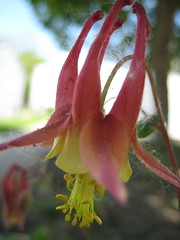
Columbine has an interesting flower with a drooping bell and five long spurs that point upward. The Canadian Columbine, Eastern Red Columbine, or Wild Columbine, Aquilegia canadensis, grows wild around here. Each year we see large stands of columbine growing on high rock ledges where parts of the earth were cut out to make way for Routes 11/15 going North through Central Pennsylvania.
The flowers of this wild columbine are red and yellow. Red outer parts and spurs contrast with yellow petals and numerous yellow stamens which are longer than the petals.
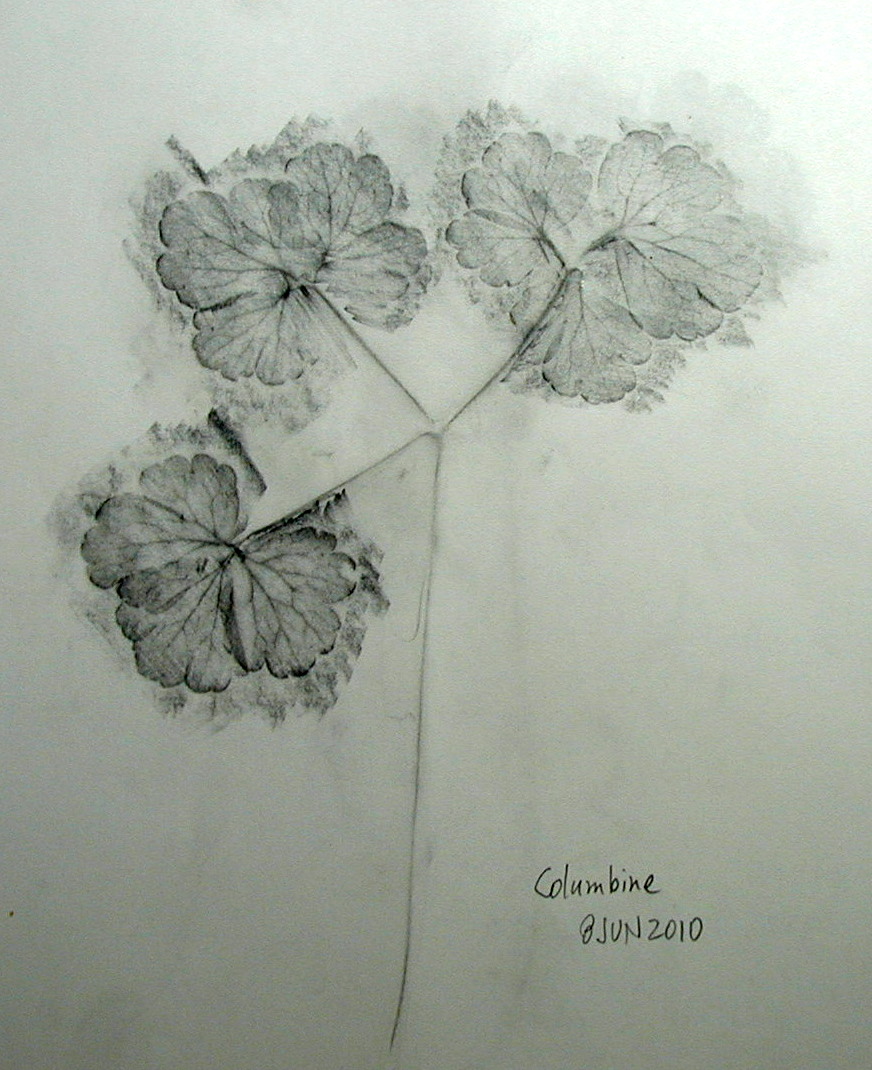
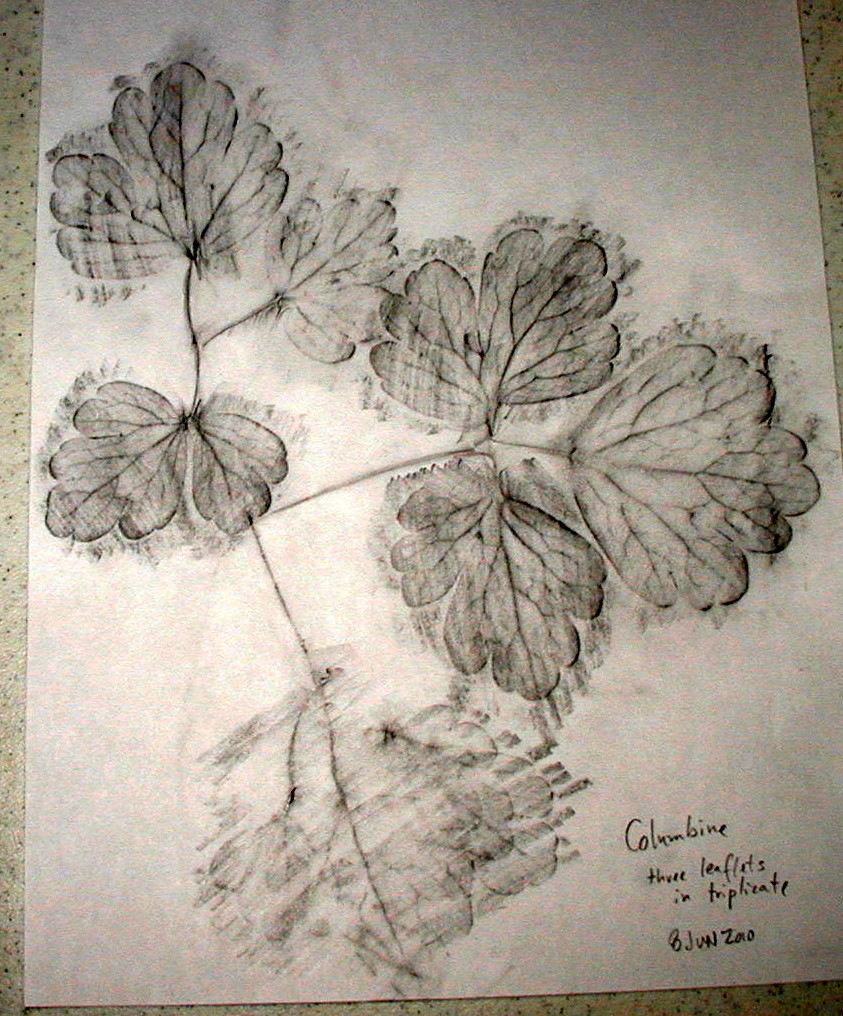
Foliage comes up in early spring and lasts through out summer. The shape of the rounded lobes varies among the triplicate leaves that are each divided in threes. Leaves of columbine are doubly compound, which means that the leaflets of a compound leaf are themselves compound.
The next two images are of leaf rubbings made simply by placing a leaf between two pieces of paper and rubbing the outside with a pencil. Rubbing over a leaf surface will bring out detail that you might not have noticed by looking at the leaf. At a minimum you’ll get a good look at the leaf edge and some of the leaf veins. Click the images below for a closeup view of the leaf structure of Columbine.
A leaf rubbing of three Columbine leaflets in triplicate. Most leaf edges overlap.Two of three Columbine leaflets in triplicate. Leaves were spread apart to illustrate the leaf and lobe shapes.
If you’re keeping columbine in a garden, cut off the flower stems after blooming unless you don’t mine the ragged look of the seed pods hovering over the foliage. Eventually, the flower stems or seed pod stems will bend over to the ground and look unsightly. If you don’t mind that look, just ignore the flower stems and the seeds may feed a bird or two or replant the columbine. Columbine is a perennial that is easily regenerated from seed.
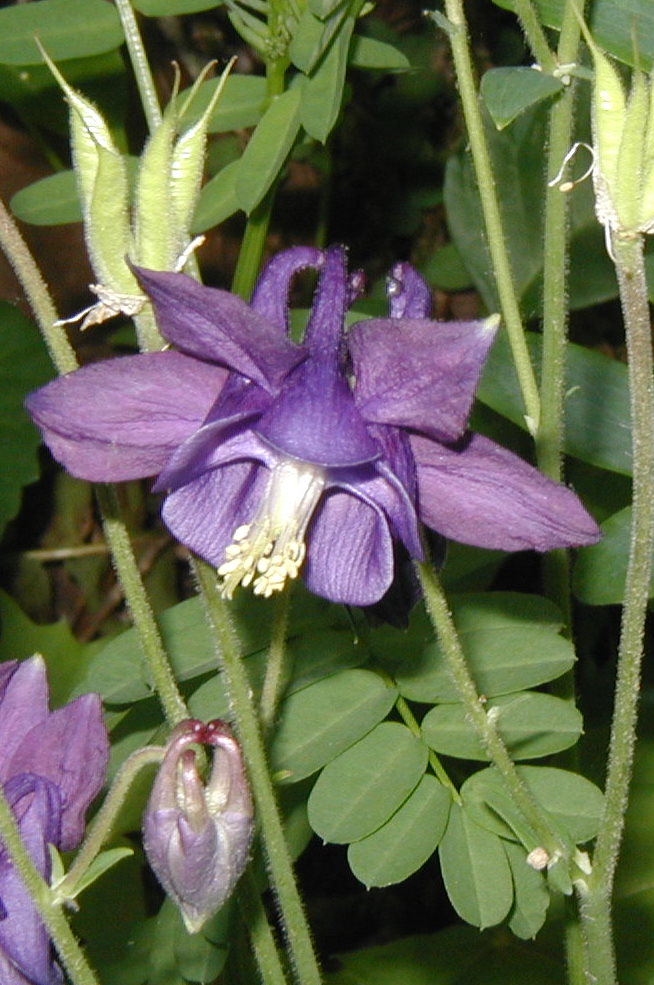
Purple-flowering volunteer Columbine.
A wild purple columbine volunteered across the road from a house where the same type of plant was observed in a flower bed. Photo taken 17 May 2010. Note the seed pods from previous flowers that are standing straight up. The foliage in the image above isn’t of columbine.
Although Native Americans used the seeds, roots and whole plant for their astringent and diuretic properties, Peterson’s Medicinal Plants Guide warns us that Columbine is potentially poisonous. This might not have been surprising if you knew that Columbine is a member of the Buttercup Family, Ranunculaceae, as many buttercups are poisonous!
As of yesterday there are 10 fewer Japanese Beetles in this world. I really don’t like killing living things, but these little buggers just had to go. How dare they munch on the cherry leaves, flowers of Echinacea and basil leaves that we want for our own?
How did they meet their end? Soapy water did the trick!
No spraying of pesticides needed.
Just take a small bucket, add a drop of liquid soap and a little water. Tap the buggers into the drink and they won’t be contributing to the next generation of beetle pests.
A plastic milk or water jug makes a great soapy water bug catcher. Cut away the top and front half of the jug leaving the handle intact and about half of the jug that will contain the soapy water.
Every day for the next couple weeks we’ll walk around the gardens removing these beetle pests. We don’t worry that we’ll decimate the beetle population or make them go extinct, because we see plenty of the beetles on tree leaves in the adjacent forest. However, we may have fewer beetles laying their eggs in the lawn that would make up next year’s grubs.
















 mentioned cemeteries specifically as one of the places this spurge plant grows. It turns out that Cypress Spurge is actually referred to as
 warns us that Columbine is potentially poisonous. This might not have been surprising if you knew that Columbine is a member of the Buttercup Family, Ranunculaceae, as many buttercups are poisonous!

