Posted by wilde on June 18th, 2006 — Posted in Vegetable
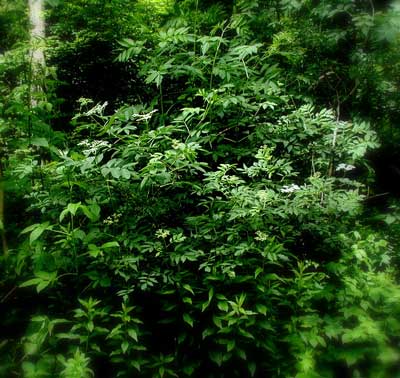
Some nicer pictures of the American elder and its clusters of white flowers.
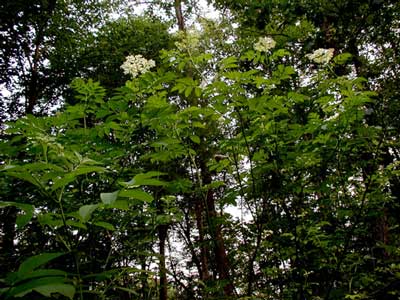
Shrubbery of the American elder tree.
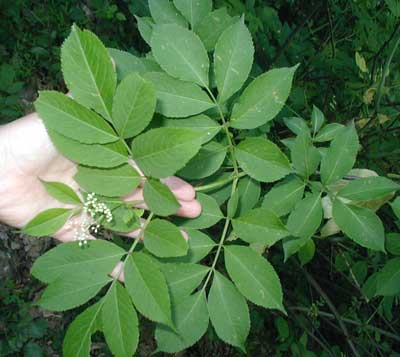
Elder leaves are compound with 5-7 leaflets.
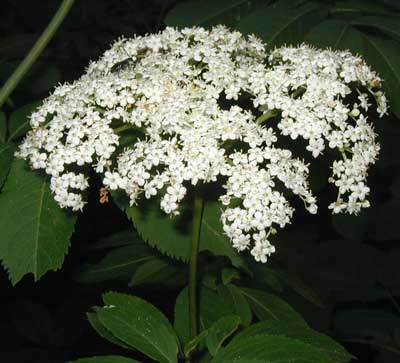
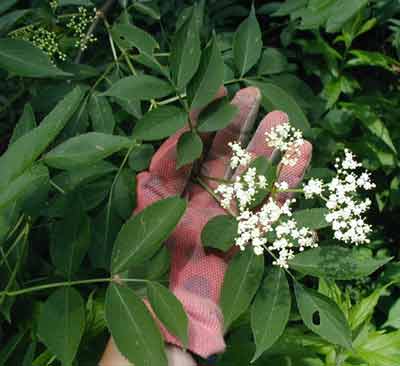
Closeup of an elder flower cluster.
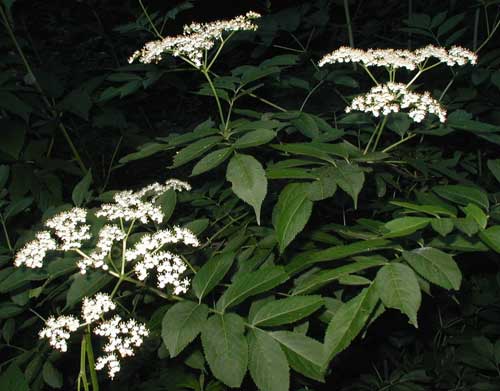
Clusters of elderberry flowers.
Here’s a nice grouping of the whorled loosestrife along the lane.
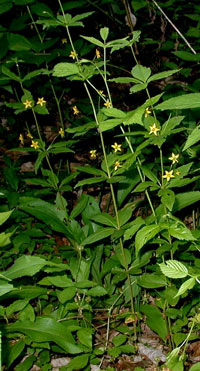
Several whorled loosestrife along the lane.
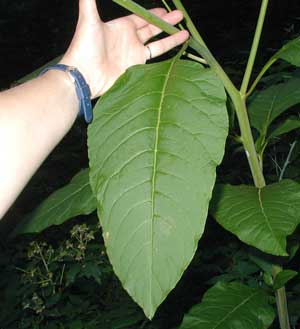
I’ve never eaten Poke, but people say it’s good greens — but only when young shoots are collected in early Spring. The mature leaves, roots and stems are poisonous. Pokeweed, Phytolacca americana, is quite noticeable as it has huge leaves!
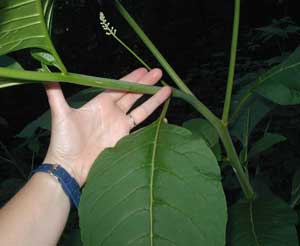
Pokeweed has huge leaves!
Poke flowers appear to have white petals, but those are actually the sepals. When the fruit ripens the cluster of shiny, purple-black berries hangs downward.
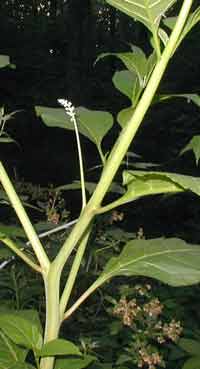
Tiny white flowers for a very large plant.
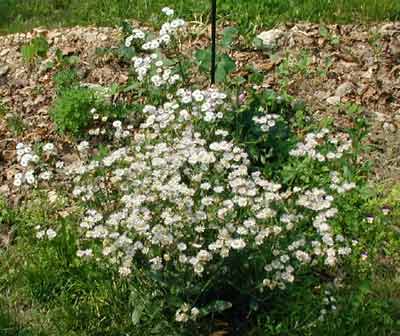
Another flowering plant we found along the lane is yarrow, Achillea millefolium, a member of the composite family, Compositae. The flowers appear in flat, tight clusters and are usually white and sometimes pink.
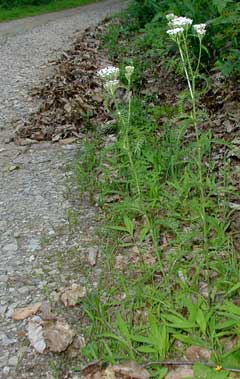
A couple yarrow plants alongside the lane.
Yarrow, a perennial, is distinguished from other similar-looking flowers by its greenery. The narrow leaves are finely divided and remind one of a fern. Yarrow leaves are aromatic, too.
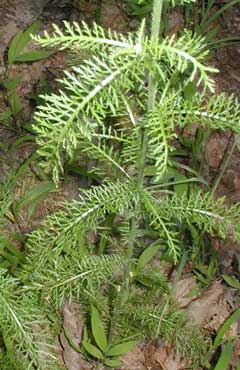
Narrow leaves with many divisions help to identify yarrow.
An interesting note about yarrow is that its use in folk medicine has been substantiated by the fact that over 100 biologically active compounds have been found in yarrow. A tea made from dried flowering yarrow is used for many maladies, including colds, fever, gastric upset, and internal bleeding. A poultice made from fresh leaves is styptic – used to stop bleeding. Indeed, legend has it that Achilles used a poultice of yarrow leaves to stop the bleeding of his soldiers’ wounds, thus the generic name Achillea. Caution: Do not use yarrow in any form if you are unsure of its identification as other similar plants are deadly poisonous, such as Fool’s Parsley and Poison Hemlock.
The tomatoes are in bloom in the vegetable garden, and the foxglove, statice, rudbeckia, tiger lilies and lamb’s ear are blooming, too.
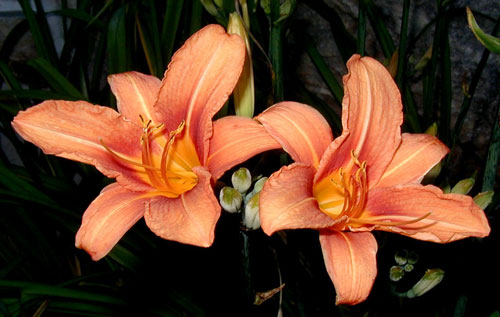
Tiger lilies blooming in the flower beds.
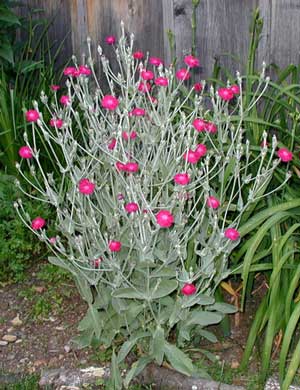
Bright pink flowers of lamb’s ear.
10 Comments »
Posted by wilde on June 12th, 2006 — Posted in Vegetable
This time of year we are seeing the raspberries beginning to appear as little green knobby buds. At about the time they should be ripening up, the elderberries shouldn’t be far behind. The American elder, Sambucus canadensis, grows with many shoots arising out of the ground. The elders here are growing along the lane up to the house and along the farmer’s road. As a matter of fact the first post I made here back in February was about the first green growth I saw in late Winter on the farmer’s lane. I reported that it was possibly a sassafras tree, but now have confirmation that it is an elder tree. The shoots that sprang up this year are 10-15 feet tall.
Elder trees grow from many shoots.
The elder leaves are compound, opposite leaves consisting of 5-7 leaflets about 3-4 inches long and sharply toothed. The small white flowers are now starting to come out of their buds and are arranged in large, roundish or flat-topped clusters about 6-7 inches across.
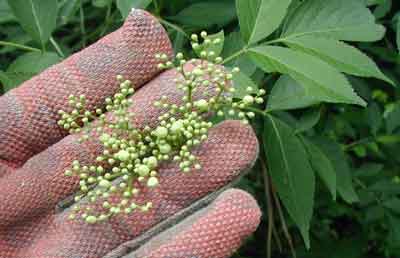
Elder flowers in bud.
Elder flowers soon to be elderberries!
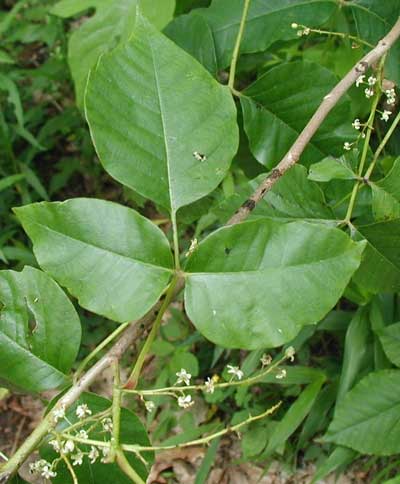
My purpose today was to chop down a large poison ivy vine but first I had to photograph the flowers. I want it gone more than I want to see the resulting ivyberries, especially since I think I’ll be back here to pick some elderberries. Here’s the typical leaves of three, so let them be! Notice the small, white five-petaled flowers arising from the leaf axils in small stalks.
Three leaves and flowers of poison ivy.
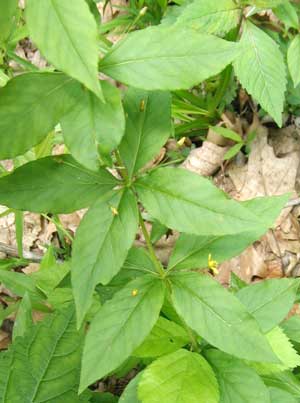
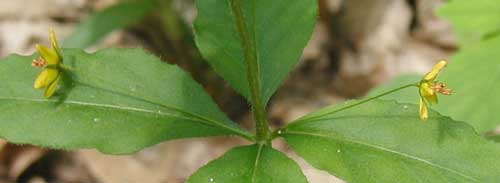
Another flowering plant that I noticed along the lane was the whorled loosestrife, Lysimachia quadrifolia, a member of the Primrose family, Primulaceae. The yellow, five-petaled flowers project from the leaf axils and lay over each leaf in a whorl on the main stem. Each whorl has typically four leaves and flowers, but I have seen a few plants with five each. This small perennial grows to 1-3 feet tall.
Whorled loosestrife whorls. How symmetrical!
Loosestrife whorled flowers.
No Comments »
Posted by wilde on June 9th, 2006 — Posted in Vegetable
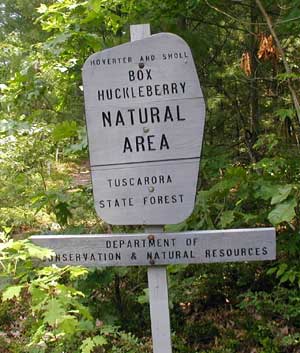
A day trip to the Hoverter and Sholl Box Huckleberry Natural Area in the Tuscarora State Forest was a delight for this first-time visit. Access is about a half-mile down Huckleberry Road from Route 34, just south of New Bloomfield, Perry County, Pennsylvania.
Hoverter and Sholl Box Huckleberry Natural Area in the Tuscarora State Forest, Perry County, Pennsylvania.
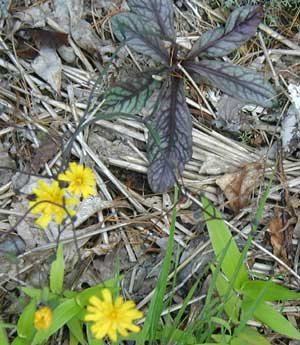
Near the entrance path there were several Rattlesnake-Weed plants as noted by their heavy purple-veined leaves at the base of a long flower stalk. At the top of the two feet long stalk are several bright yellow flowers in daisy-like fashion indicating that rattlesnake-weed, Hieracium venosum, is a member of the composite family.
Rattlesnake-weed flowers are held about two feet above the basal rosette of purple-veined leaves.
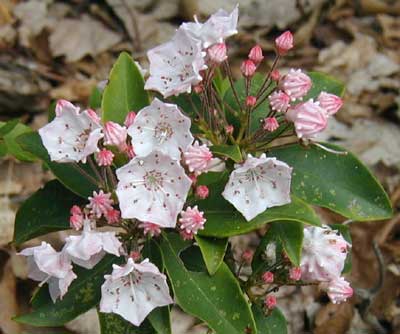
We were greeted by a nice display of Mountain Laurel on entering the easy half-mile trail. Mountain Laurel, Kalmia latifolia, is an evergreen shrub or small tree having large oval leaves that remind one of a rhododendron and is a member of the heath family.
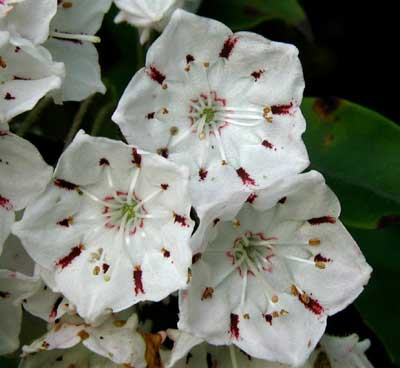
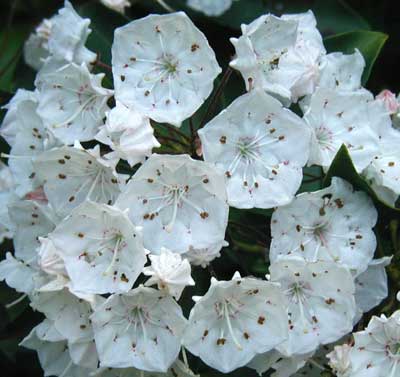
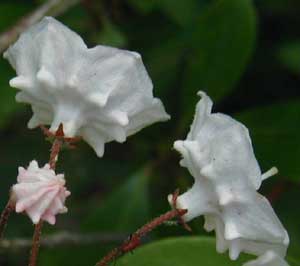
Mountain laurel blossoms vary from nearly all white to pink. Each stamen appeared to be placed in a pocket of the blossom where some maroon color was transferred from the anther to the petals producing a deep red spot on the blossom. A most unusual flower!

Some Mountain Laurel flowers have spots of deep red color transferred from the anthers.

Some blossoms are nearly all white.
Check out these buds waiting to open – they look like beautiful dremel tool tips! Each has ten stamens wrapped inside the 10-parted flower.
The rear of the Mountain Laurel flower has a unique shape.
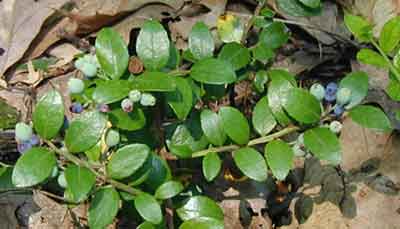
The Box Huckleberry is also a member of the heath family and is a low-growing evergreen shrub. The leaves are about an inch long, oval in shape and have a glossy, leathery appearance, much like the boxwood that it is named after.

The Box Huckleberry has evergreen, leathery leaves and blue fruit.
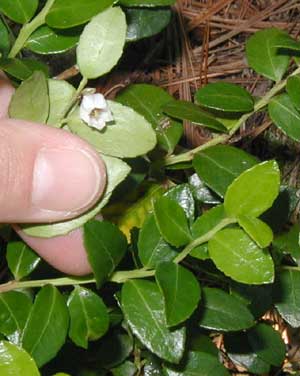
Huckleberries can be mistaken for blueberries as their flowers and fruit are similar in appearance. The blossoms are white and bell-shaped. The box huckleberry fruit is small and contains several large seeds that make the fruit undesirable, except by grouse, turkey, and other wild creatures.

The blossom of the Box Huckleberry reminds one of blueberry blossoms, a close relative.
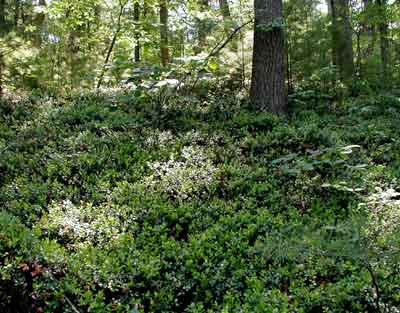
An interesting feature of this box huckleberry is that it is a single plant approximately 1,300 years old! The plant grows via rhizomes at a rate of only six inches per year. The size of the plant tells its age. A separate plant in the next county was estimated to be 13,000 years old – easily the oldest organism on the planet! Unfortunately, most of that large box huckleberry was destroyed in a road-building project for Route 22/322. Remnants of the original plant are said to be located on private property. Read more about the history of the box huckleberry.

Part of the Box Huckleberry colony in the Tuscarora State Forest in Pennsylvania.
Box huckleberry is an endangered species that can only be found in 9 US states, with a most recent find of a new box huckleberry plant in the mountains of North Carolina.
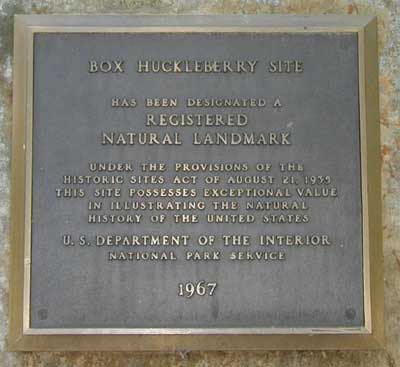
As a matter of fact the Hoverter and Sholl Box Huckleberry Natural Area is designated as a natural landmark.

Natural Landmark Register Plaque on Monolith
This little piece of land was set aside to protect the rare Box Huckleberry in 1967!
3 Comments »